

Carefully selected materials that deliver exceptional print quality, durability, and shelf presence.


 New
New














Custom Packaging Boxes for E-Commerce: Shipping That Protects and Impresses
Every order that leaves your warehouse is a small bet. You are betting that the box holds up through three carrier scans, one transfer hub, a delivery vehicle, and a front porch drop. You are also betting that when your customer slices through the tape, the first thing they feel is confidence in your brand, not disappointment at a crushed corner or a rattling product. That is a lot of weight for a box to carry, and a plain brown shipper was never built to do both jobs at once.
Custom packaging boxes for e-commerce are built differently. They are sized to your product, printed to your brand, and engineered to survive the specific abuse of modern parcel networks. The brands winning repeat business in 2026 are not the ones with the lowest price point. They are the ones whose package arrives looking like someone cared. This guide walks through every layer of that decision, from how L x W x H measurements shape your shipping costs to how the right insert turns a first-time buyer into a loyal one.
Why Is the Box Never Just a Box in E-Commerce?
Retail has a shelf while E-commerce has a doorstep. That difference changes everything about what packaging needs to do. In a store, a shopper sees your product before they touch it. The shelf facing, the color block, the label all do the persuasion work. Online, the product page does that work, and by the time a physical item arrives, the customer has already paid. Our guide to common box sizes and styles demystify the real case scenarios and showcases what matters the most.
The box is now the first real, tangible proof that your brand delivers on what your website promised. Custom printed boxes give brands a way to extend that promise into the physical world. A mailer printed with your logo and a warm inside message does not cost dramatically more than a plain brown box at volume, but what it does is signal that your business is deliberate. Customers notice deliberate. They share it. They come back for it.
There is also the practical side. Custom made boxes sized to your actual product reduce the need for excessive filler, cut your dimensional weight charges, and lower the chance of in-transit movement that causes damage. Fewer damaged orders mean fewer returns. Fewer returns mean better margins and better reviews. It all connects back to the box.
Understanding L x W x H for Shipping E-Commerce Boxes
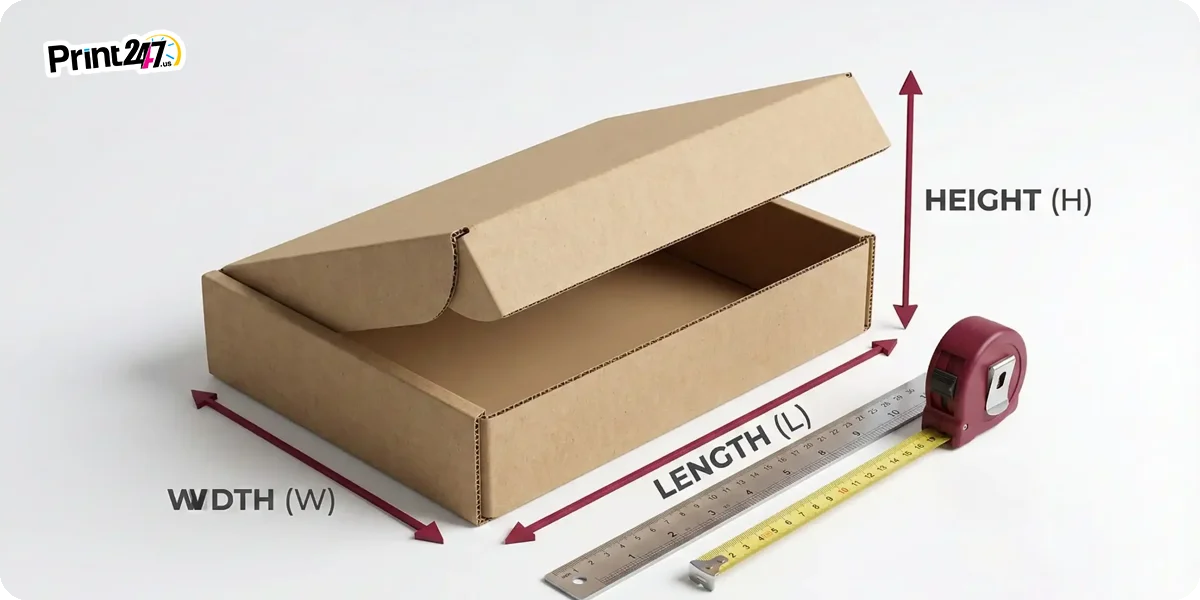
Before you even think about where to put your logo, you really need to get the box measurements right. In the U.S., we always measure them as Length x Width x Height
(L X WXH). It’s simpler than it sounds: the Length is the longest side of the opening, the Width is the next longest, and the Height, sometimes called Depth, is just how tall the box sits once the flaps are closed. This matters so much for e-commerce because carriers like UPS and FedEx don’t just look at how heavy your package is. They use something called "dimensional weight". Basically, if your box is big but light, they’ll charge you for the space it takes up in the truck rather than its actual weight on the scale.
“Corrugated and Kraft mailers specifically are seeing a higher adoption rate, with a projected valuation of $2.3 billion by 2030 in the US alone” FutureMarketInsights
How Does Math Hits Your Wallet ?
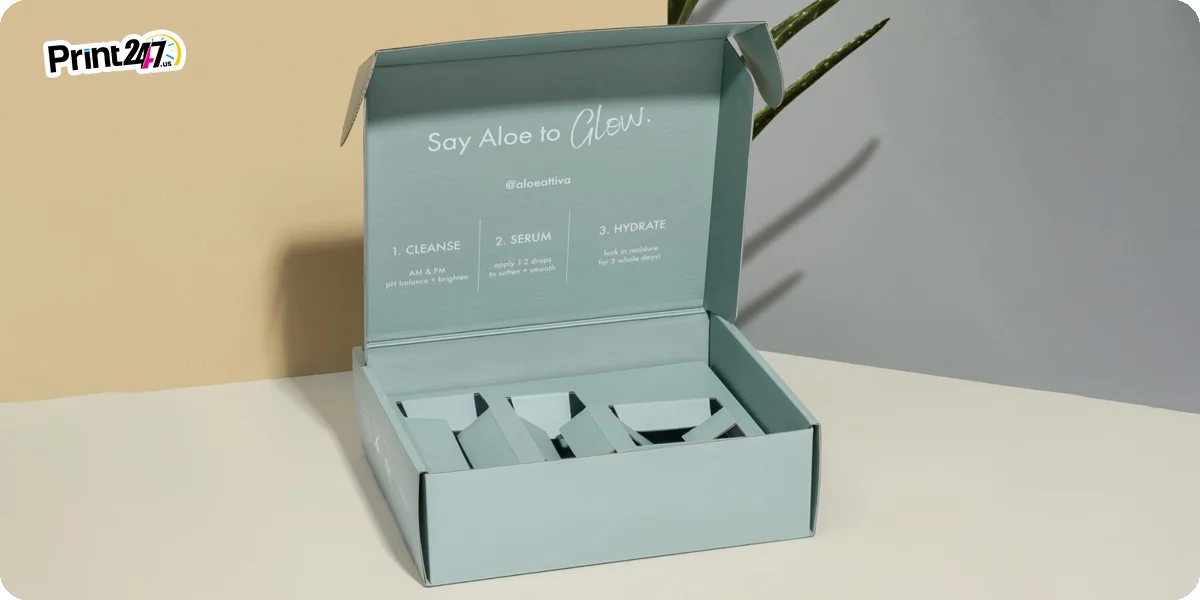
For custom packaging and shipping within the U.S., carriers generally use this formula: (Length x Width x Height) divided by 139. For the purpose of showing how it works you how that works in the real world:Imagine a box that is 14 x 10 x 6 inches. it gives you a total of 840. When you divide 840 by 139, it comes out to roughly 6.1 pounds. When the item you intend to ship weighs up to 2 pounds, you’re still stuck paying the 6.1-pound rate on every single order. You are essentially paying to ship a lot of empty air, which can eat into your profits faster than you’d think.
How Custom Product Packaging Keeps You Within Budget?
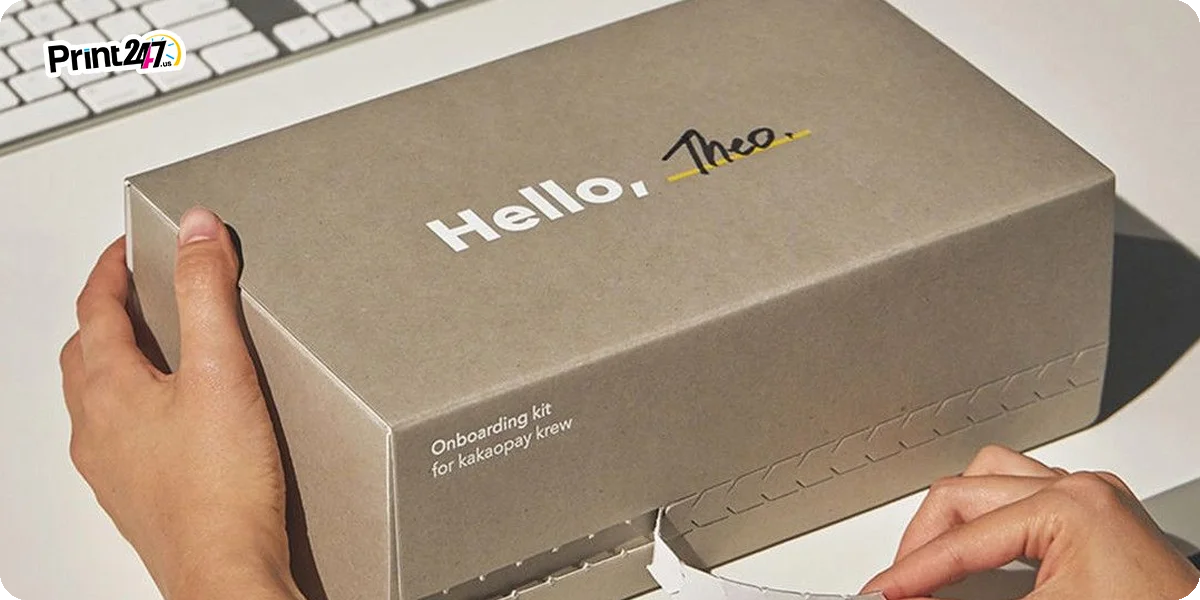
This is exactly where custom boxes for shipping pay for themselves. When your box is built around your product rather than pulled from a shelf of standard sizes, you eliminate the air you are paying to ship. Brands that go through this exercise often find they can reduce their per-shipment cost by a meaningful amount on their most frequent SKUs.
Common L x W x H ranges for e-commerce categories:
Product Type | Suggested Box Dimensions (L x W x H) |
Jewelry and accessories | 6 x 4 x 2 in |
Apparel, folded | 12 x 9 x 4 in |
Skincare and wellness kits | 10 x 7 x 4 in |
Tech accessories | 12 x 8 x 6 in |
Home goods, small | 14 x 10 x 6 in |
Subscription box, standard | 12 x 12 x 6 in |
Footwear | 15 x 10 x 6 in |
Bulkier gifts or bundles | 18 x 14 x 8 in |
These are starting points. The right dimension for your product is whatever keeps the item snug with minimal filler while not touching the box walls directly. A good rule is to allow at least half an inch of clearance on all sides when inserts are in place.
Defining Length, Width, and Height with Precision
Length is representing the longest side, while width is the shorter horizontal measurement. While the height is vertical distance from base to top when flaps get closed. This standard L × W × H order creates consistency across custom packaging boxes for e-commerce. When you get to know the types of custom boxes and their accurate dimensions eliminate guesswork, ensuring your box fits the product snugly while aligning with carrier requirements.
Internal versus External Dimensions: A Critical Distinction
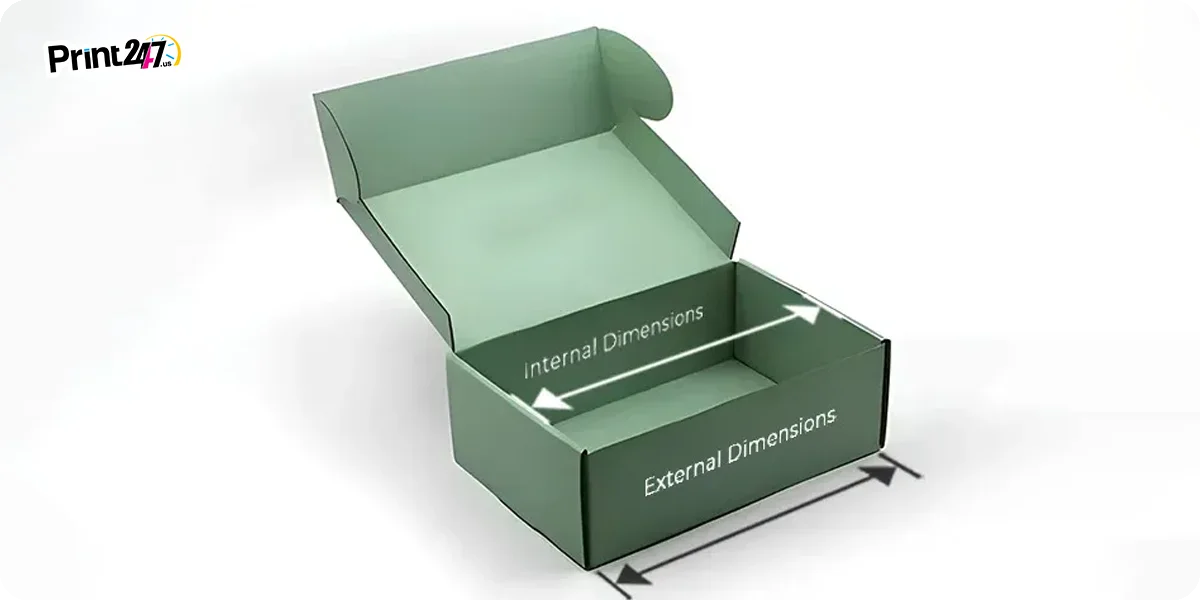
Many brands overlook the difference between internal and external dimensions. Internal measurements determine usable space for your product and inserts, while external dimensions drive shipping calculations and storage planning. Measure with the box on a flat surface: longest side first as length, then width, followed by height. Allow 0.25 to 0.5 inches of clearance for protective materials.
Volume calculation further sharpens decisions to multiply Length × Width × Height for cubic inches. This reveals true space usage and helps avoid 2D flat packaging pitfalls versus true 3D structures for bulkier items.
Strategic Impact on Costs, Protection, and Branding
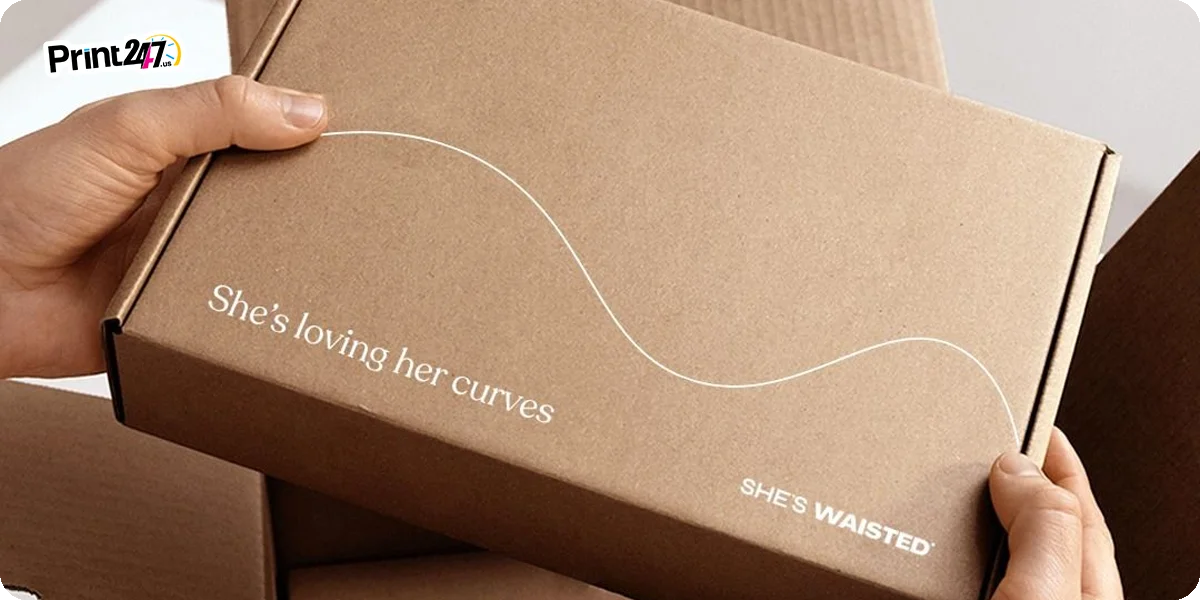
Precise length, width, and height directly cut dimensional weight fees and reduce filler needs, boosting margins. Beyond savings, they enable elegant unboxings that reinforce brand trust. Right-sized custom packaging boxes signal intentionality, lowering damage rates and inspiring shares that amplify visibility.
By mastering these fundamentals, your e-commerce shipments protect products while delivering memorable experiences. This knowledge-driven approach positions your brand as reliable and premium.
How Custom Packaging Boxes Follow a Hierarchy?
Not all boxes carry the same responsibility. One of the most useful ways to think about packaging decisions is through a structural hierarchy. Each level of that hierarchy has a different job, and the best brands are deliberate about what they ask of each one.
Primary Packaging
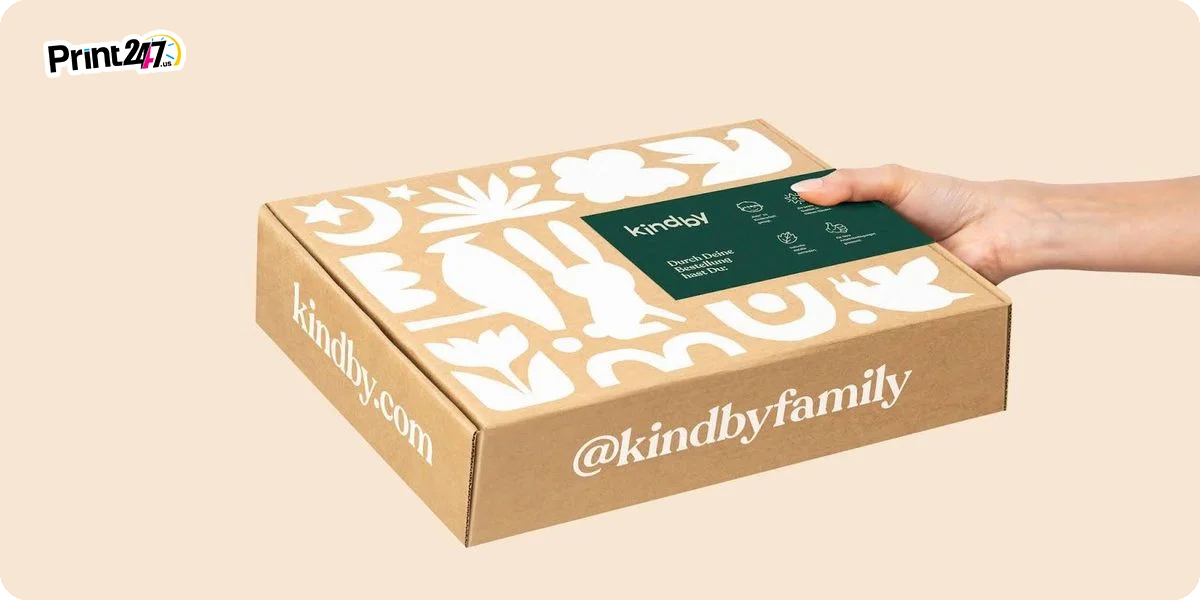
This is the layer that directly contains or touches the product. Think of a folding carton around a candle, or a rigid box holding a watch. Primary packaging is about presentation and product safety at the point of first contact. It sets the tone for the brand experience and is usually what gets photographed in unboxing videos.
Secondary Packaging
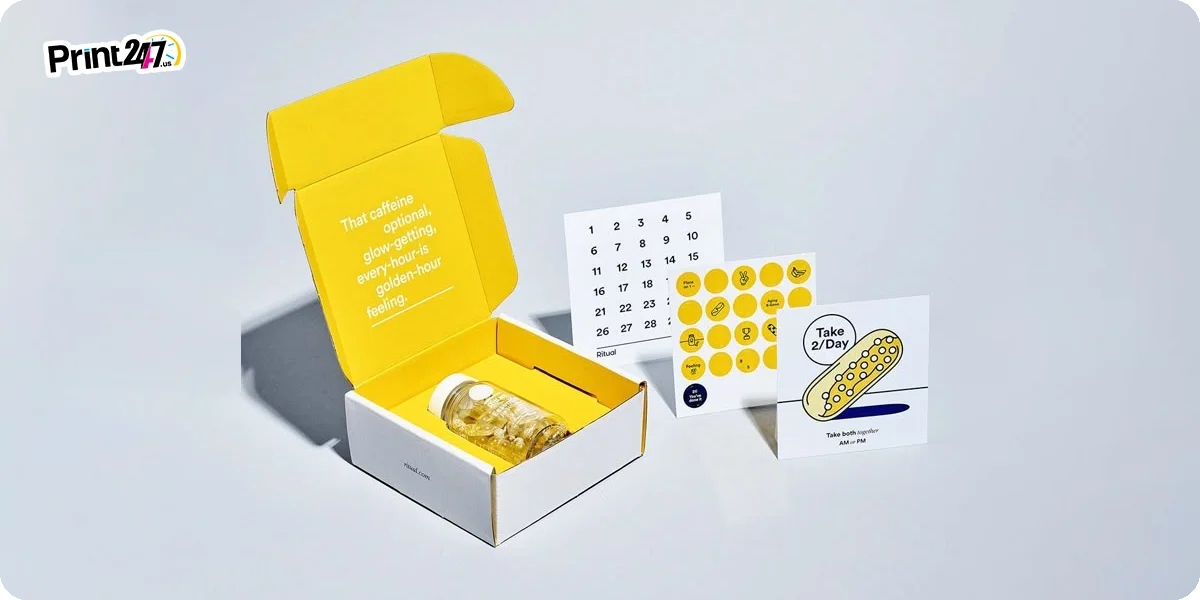
This is the shipping layer, the outer box that protects the primary packaging through transit. For most e-commerce brands, this is a corrugated mailer box or a shipping box. Did you know that secondary packaging needs to handle the compression? From stacking weight , stacking weight, and rough handling without transferring that damage to what is inside.
Tertiary Packaging

This level applies mostly to brands shipping palletized freight or wholesale orders. When it is about tertiary it refers to the outermost layer they are stretch wrap pallet boxes. They are bulk corrugated, and exist purely for logistics efficiency.
For direct-to-consumer e-commerce, the sweet spot is often a single box that serves both the primary and secondary role, especially for mid-range and premium products. A well-designed, sturdy custom mailer box can present the product beautifully and survive shipping without a separate outer shipper. This consolidation saves cost and eliminates the disappointing moment when a customer opens a plain brown box only to find a beautiful inner box that the carrier has already crushed.
The Hierarchy of Custom Boxes That Infer Success
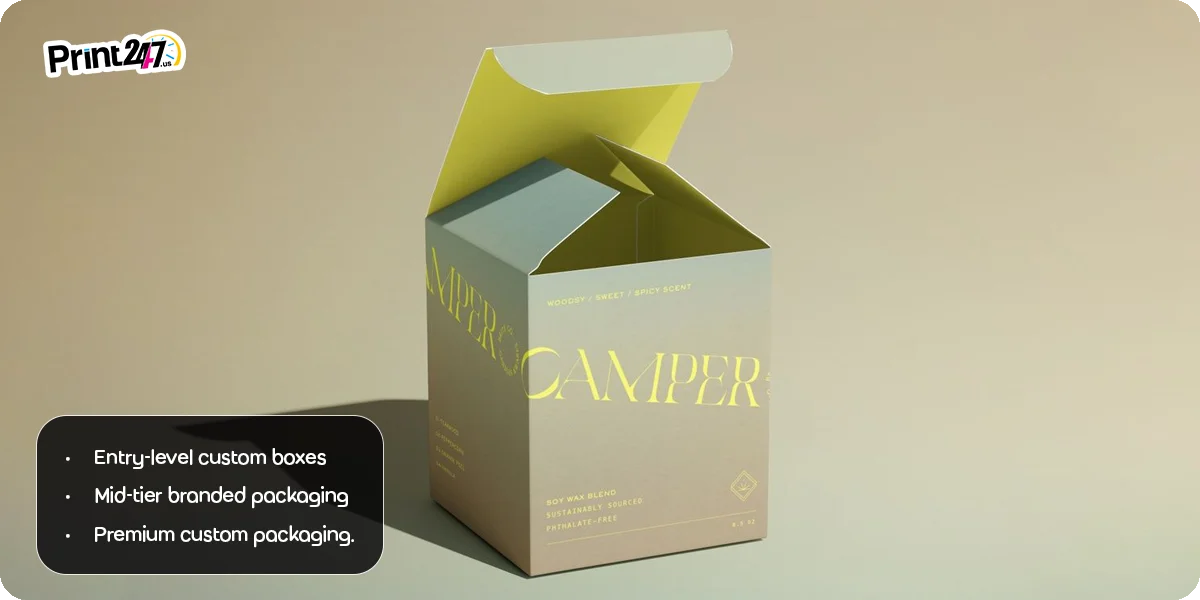
There is a second kind of hierarchy worth understanding, not structural but strategic. It is about what level of investment in packaging is appropriate for different stages of your brand and different price points in your catalog.
Entry-level custom boxes are plain corrugated mailers with one-color exterior printing. Your logo, your URL, perhaps a brand color on the outside flap. Appropriate for high-volume, low-margin products where the package serves a functional purpose first. It still beats plain brown.
Mid-tier branded packaging adds full-color exterior printing, a brand message inside the lid, and a tissue paper layer or basic insert. This is where customers start to feel the difference and where unboxing content gets created organically. Most scaling e-commerce brands live at this tier.
Premium custom packaging introduces rigid boxes, magnetic closures, custom foam or pulp inserts, foil stamping, soft-touch lamination, or embossed logos. Appropriate for products priced above $75, luxury categories, and subscription boxes where the experience is part of what the customer paid for. The per-unit cost is higher, but the repeat purchase and referral value it generates makes the math work.
Knowing where your product falls in this hierarchy helps you avoid both under-investing and over-investing. Sending a $90 item in a plain brown box leaves opportunity on the table. Spending $4 per unit on rigid packaging for a $12 product eats your margin. The right level is a deliberate choice, not a default one.
Crush Resistance: The Spec Nobody Talks About Until an Order Breaks
Every custom box for shipping has a burst strength or an edge crush test rating. Most e-commerce brands never ask about it and they should. Burst strength, measured in pounds per square inch, tells you how much direct pressure a wall of the box can withstand before it punctures.
Edge crush test, or ECT, measures how much stacking weight a box handles before it buckles. For most standard e-commerce shipments, a 32 ECT single-wall corrugated box is the minimum. For heavier products or fragile goods, a 44 or 48 ECT double-wall box gives meaningful additional protection.
The mistake brands make is choosing a box based on price per unit without understanding the board grade they are getting. A cheaper box that results in a 3% damage rate on a $60 product is far more expensive than a better-specced box that brings that rate below 0.5%. At Print247, every custom box for shipping is built from board grades matched to your actual use case, product weight, and carrier conditions.
Dimensional Weight Pricing: The Hidden Tax on Oversized Boxes
Dimensional weight pricing was mentioned earlier in the context of measuring your box, but it deserves its own treatment because it is one of the most consistent sources of avoidable cost in e-commerce operations.
Carriers introduced dimensional weight pricing because large, light boxes take up disproportionate space in delivery vehicles. The formula penalizes you for shipping air. Every inch of empty space inside a box that is too large for your product is space you are paying for, twice: once in the dimensional weight surcharge, and again in the extra void fill material you need to prevent the product from shifting.
The compounding effect is real. A brand shipping 500 orders per week with boxes averaging 2 inches too large in each dimension can spend thousands per month on unnecessary charges. Rightsizing your custom printed boxes to your actual product dimensions is one of the highest-return packaging decisions you can make. Order a short run sized precisely to your top-selling SKUs, run them for 60 days, and compare your per-shipment cost against the previous average. The savings usually cover the custom tooling cost within the first quarter.
Branded Unboxing: Where Packaging Becomes Marketing
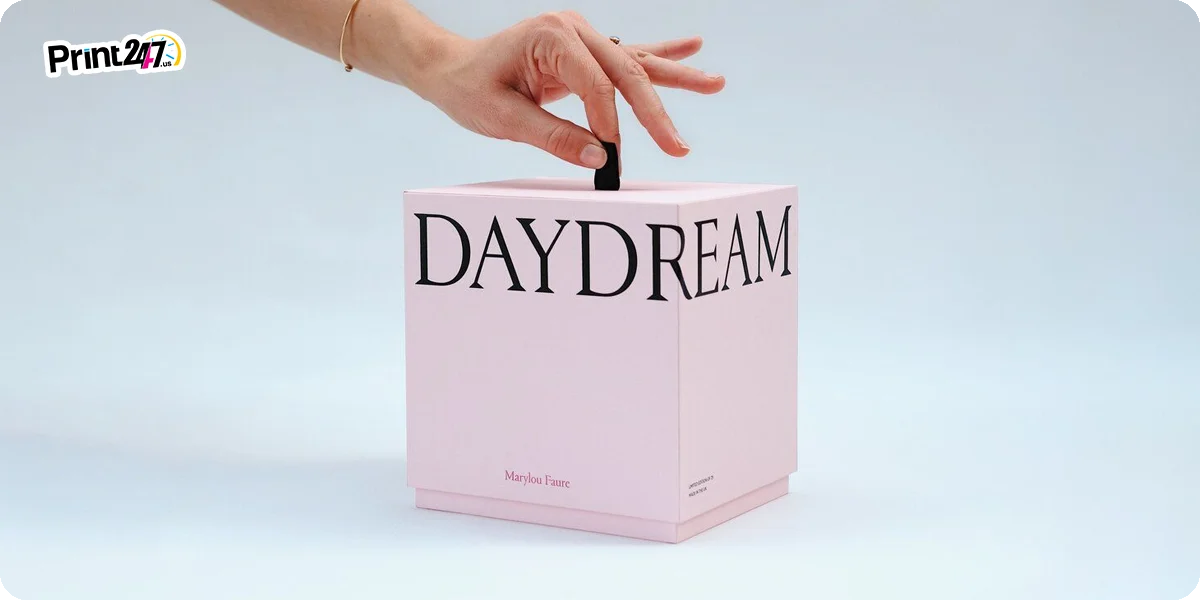
In 2026, unboxing is a content format. Customers film it, photograph it, and share it. Brands that understand this are generating word-of-mouth without buying a single ad impression.
A branded unboxing experience does not require a massive budget. It requires intentionality. The outside of the box sets expectations. A clean logo, a brand color, a short line of copy. It should feel cohesive with your website and your social presence. When someone photographs that box on their doorstep, your brand is in the frame.
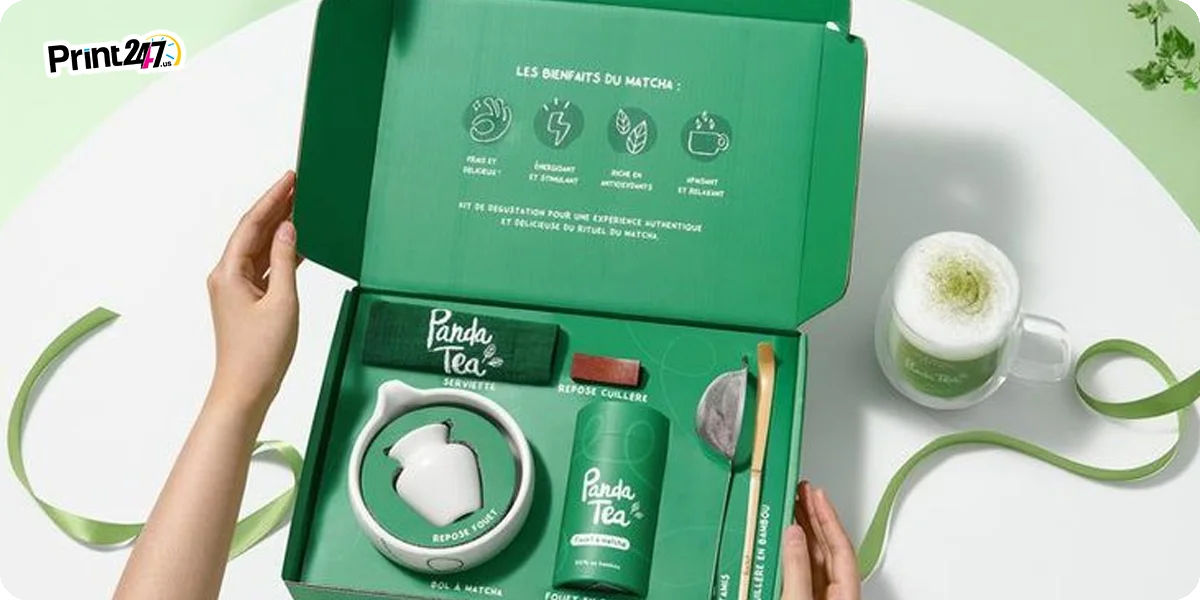
The inside is where the experience deepens. Tissue paper in a brand color, a thank-you card, a small insert with a brand story or product tip. None of these are expensive at volume. All of them create a moment that feels personal. That feeling drives a customer to come back, and to tell someone else about you.
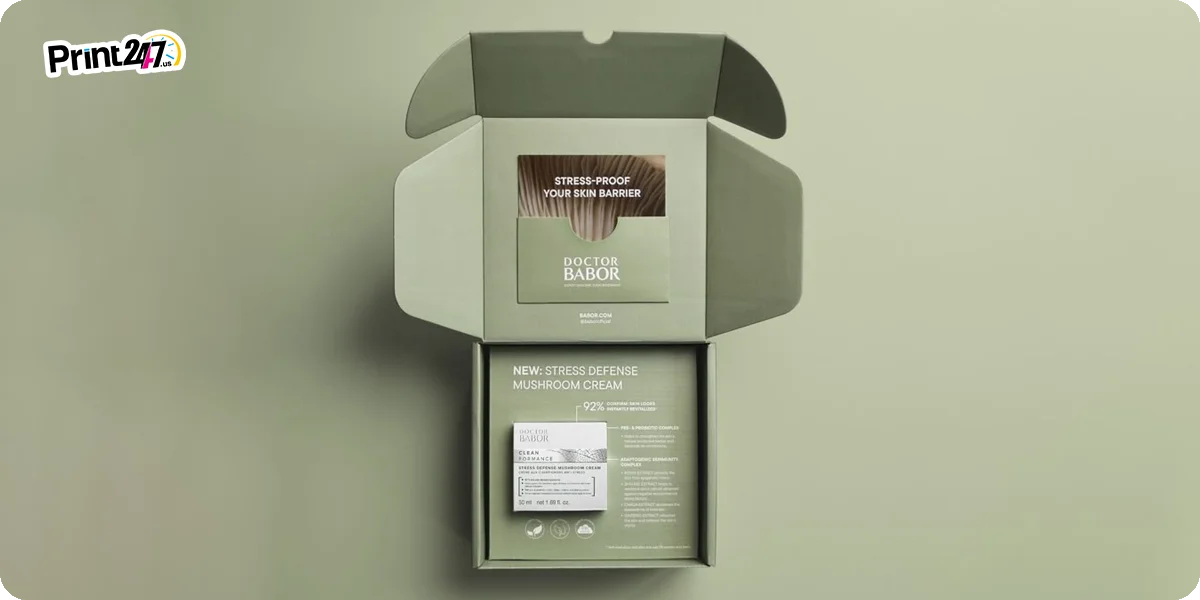
Custom printed boxes with interior printing are a growing category at Print247 precisely because brands have recognized that the inside of the lid is prime real estate. It is the first thing a customer sees when they open the box. Use it.
Insert Options: Protecting the Product and Elevating the Feel
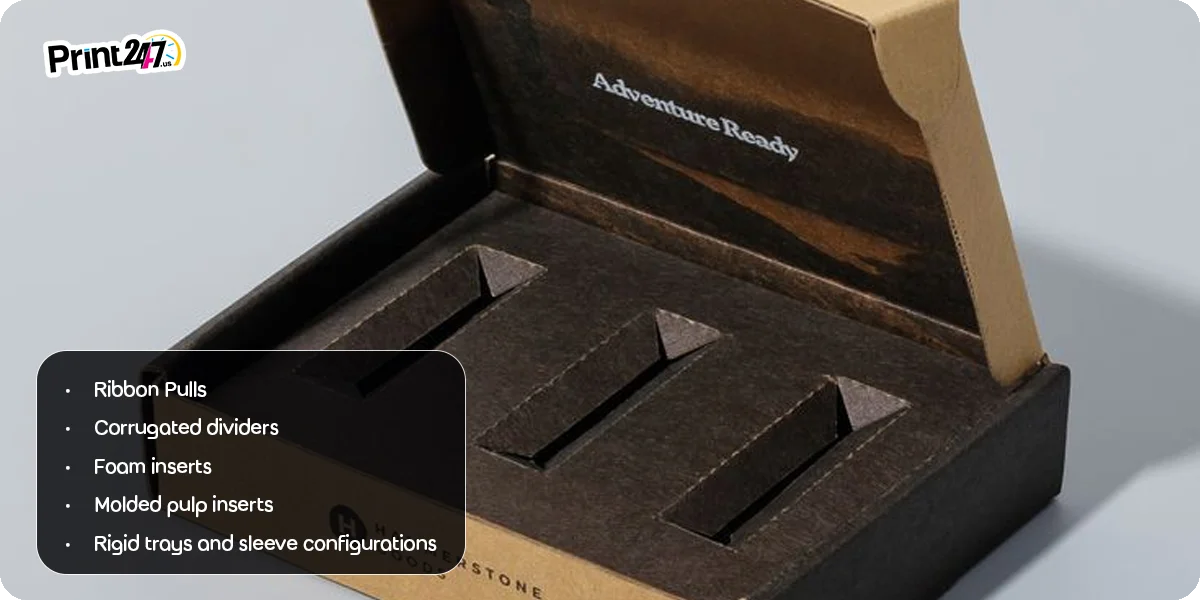
The right insert does two things at once. It holds the product securely so nothing shifts in transit, and it signals quality to the customer who opens the box.
Ribbon Pulls
Tissue paper and ribbons can add visual warmth and light surface protection. It works well for apparel, accessories, and beauty products where the tactile reveal matters as much as what is inside.
Corrugated dividers
These corrugated dividers in shipping boxes are actually the best for practical needs for multi-item orders. A custom die-cut corrugated insert keeps each item in its own compartment, prevents glass from touching glass, and reduces transit damage in gift sets and bundles significantly.
Foam inserts
Adding foam inserts to custom mailer boxes that are the right choice for fragile or high-value items. Electronics, glassware, and anything with a sensitive surface are natural fits. Die-cut to the exact product shape, foam inserts deliver a fitted, premium feel that customers remember.
Molded pulp inserts
are a popular sustainable alternative. Made from recycled paper fiber, they are compostable, structurally effective, and photograph well, which matters when customers share their unboxing.
Rigid trays and sleeve configurations
They sit at the premium tier. The product rests elevated in a tray, the sleeve slides off with satisfying resistance, and the opening sequence feels like an event. This standard appears across premium cosmetics, tech accessories, and curated gift boxes.
The right insert choice lowers your return rate by preventing damage and reduces your void fill spend, often more than offsetting the insert cost across a full production run.
How the Right Custom Box Lowers Return Rates and Increases Repeat Purchases?
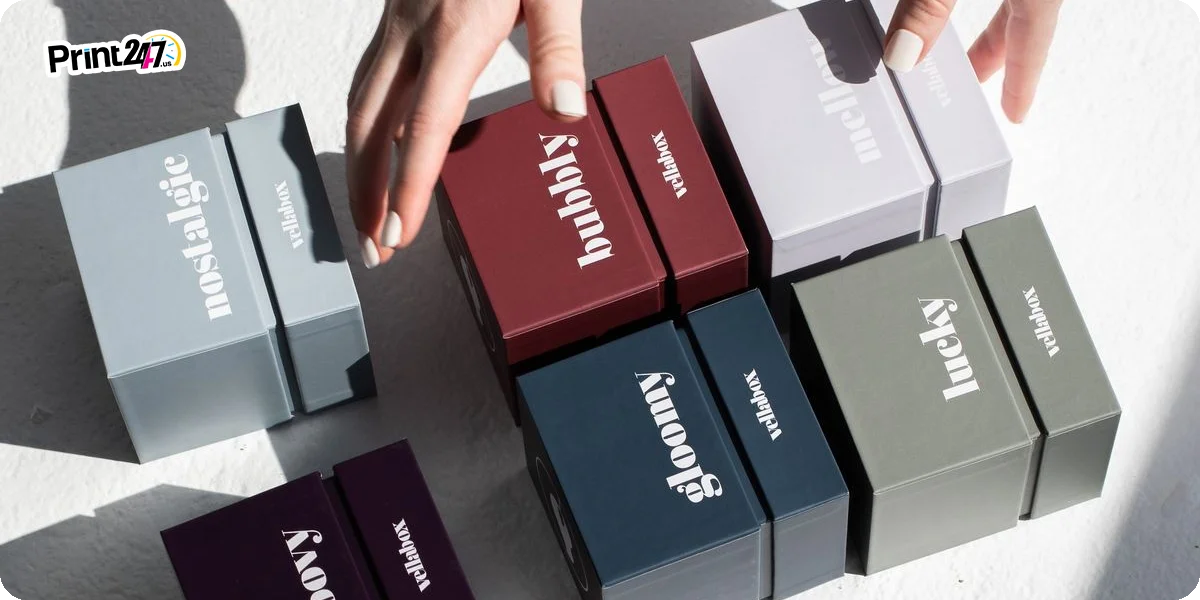
Returns are expensive and their average cost to process an e-commerce return in the U.S. includes reverse logistics, inspection, repackaging, and the lost sale margin. For most categories, a returned order costs between 20% and 65% of its original value to process, depending on whether the product can be resold. The custom apparel boxes are made in a pristine manner so that return rates are reduced.
Damage-related returns are the most preventable category. When a product arrives broken because the box failed or the product shifted in transit, that is a packaging problem, not a product problem. Brands that move from generic shipping boxes to properly sized, properly specced custom made boxes consistently see damage-related return rates drop. A box sized to the product with the right insert eliminates the most common failure points in one move.
Repeat purchases connect to packaging through a different mechanism. The customer who receives a well-protected, visually considered order associates that quality with your brand. That feeling lowers the friction to buying again. Combined with a discount code on a next purchase inside the box, a well-designed custom box becomes a retention tool with measurable ROI. Print247 helps e-commerce brands get both right, whether you are shipping your first 500 units or scaling to tens of thousands of orders per month.
Branding That Does Not Shout but Always Lands
The best packaging branding does not try to do everything. It knows what it is, shows up consistently, and leaves an impression without overwhelming the customer.
A single strong brand color on the exterior of a corrugated mailer is enough to make the box recognizable at the doorstep. A logo in white on kraft makes a clean statement. A short line of copy inside the lid, something as simple as "You're going to love this," is enough to make the customer smile before they have even seen the product.
What branding on custom packaging boxes for e-commerce should not do is compete with the product. The box opens the conversation. The product closes the sale. When packaging is done right, the customer feels understood before they have even lifted the product out. That is the standard worth aiming for.
At Print247, our design team works with e-commerce brands at every scale to build packaging that hits this balance. From the shipping boxes to gable gift boxes we work firmly to facilitate your brand to new heights. Free design support, physical samples before production, and print quality that holds the color and detail your brand identity demands. When your custom packaging boxes for e-commerce are built this carefully, every order becomes a small ambassador for everything your brand stands for.
Ready to build packaging that protects your product and grows your brand? Talk to Print247 today and get started with custom printed boxes designed around your exact dimensions, your products, and the experience you want every customer to remember.
Get a Quick Quote

More Articles
 Bill ‘Hogg’ Ryan
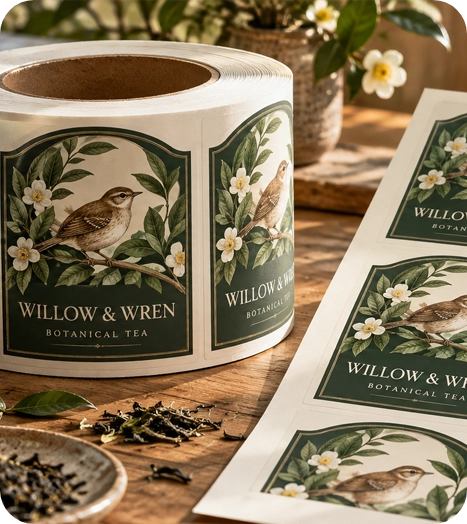
Roll Labels vs Sheet Labels and When Each One Makes Sense
 Bill ‘Hogg’ Ryan
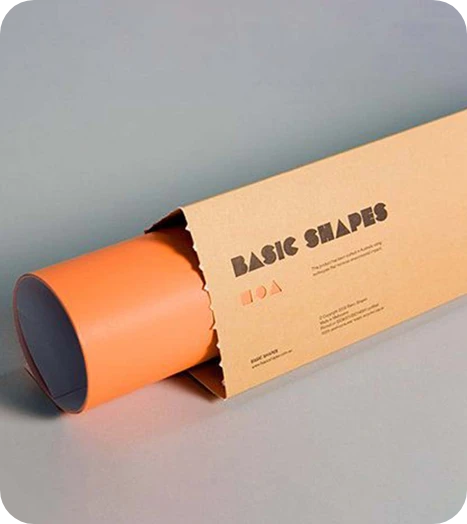
Why Triangle Mailing Tubes Are a Cost-Effective Alternative to Custom Boxes
 Bill ‘Hogg’ Ryan