

Carefully selected materials that deliver exceptional print quality, durability, and shelf presence.


 New
New












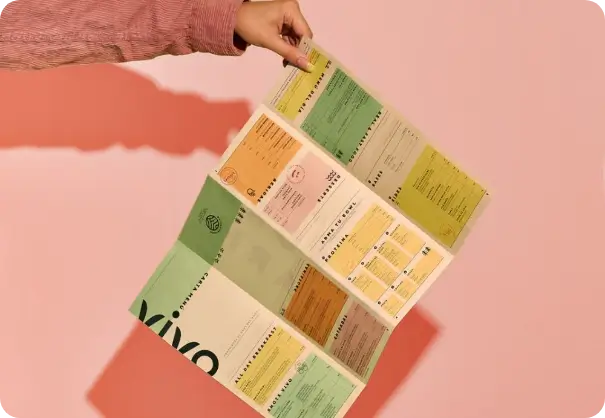


What is Large Format Printing: Types, Uses, and Benefits Explained
.jpg)
Large format printing is a printing method in which we produce extra-large graphics such as banners, signs, posters, and displays for brands. This technique is performed with the help of specialized printers called “large format printers” like DesignJet or SureColor. This technique uses heavy-duty inks and wide materials to create high-impact visuals.
Large format printing method helps businesses turn big ideas into clear visuals that people can see from far away. When you need a banner across a storefront, a wall graphic in a lobby, or a full booth backdrop at a trade show, you move beyond standard desktop prints and step into large format printing.
As a brand or marketing team, your main problem is to get the audience's attention. You fight clutter in retail aisles, busy streets, and noisy events. You need simple, bold visuals that speak fast and match your brand colors. That is where large format printing services and other large printing services give you an edge.
The purpose of this blog is to make you aware of what wide format printing is, how it works, there are different types, the benefits for your business, and how it compares to small format printing. You will also see how large format printing companies like Print247 support brands with design help, fast large format production, and consistent quality for every large sign, poster, or display.
Key Takeaways
- Large format printing is a method used to print large graphics, usually wider than 18 to 24 inches, on rolls or rigid boards.
- Large format digital printing helps brands create banners, posters, and print signage that are easy to read from a distance.
- Large format printing services support many materials, including vinyl, fabric, foam board, and paper for large posters and prints.
- Common outputs include banners, trade show displays, large sign panels, wall graphics, and floor decals.
- Main print types include UV or LED cured, latex, dye sublimation, solvent, and aqueous large format production methods.
- A clear file setup and print-ready artwork reduces large format printing costs and speeds up turnaround.
- The right large format print shop can balance quality with affordable large format printing for ongoing campaigns.
- Large format printing online ordering makes it simple for marketing teams in different locations to submit jobs and reorder.
- Working with expert large format printing companies like Print247 keeps brand colors consistent across every campaign.
What Is Large Format Printing?
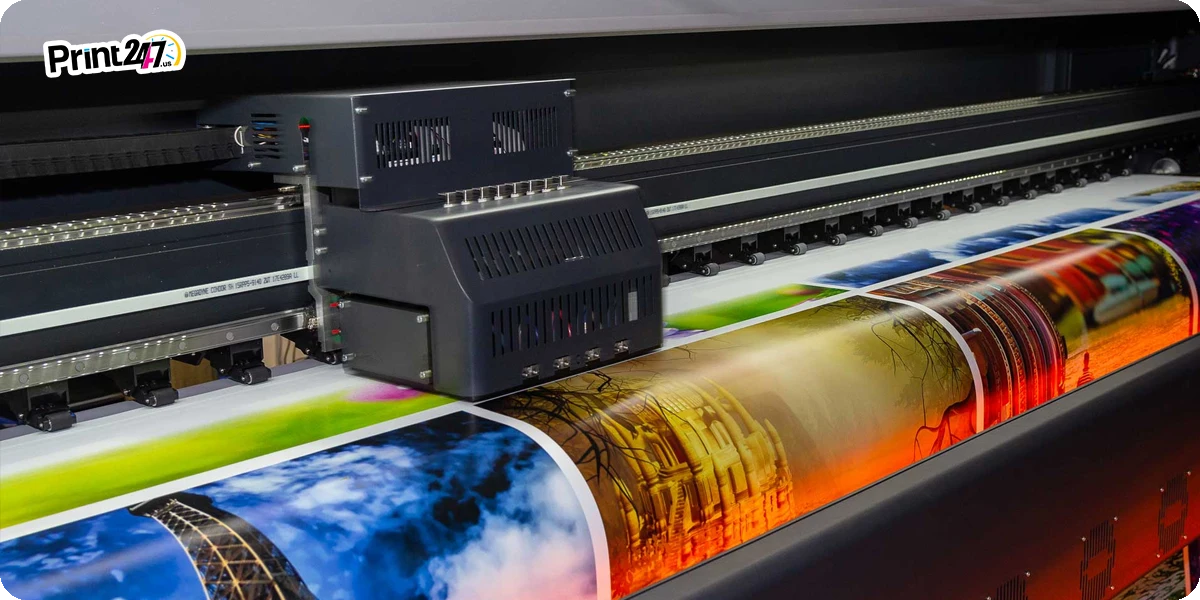
Large format printing, also known as wide-format printing, is a specialized printing method that produces graphics that are larger than standard office or desktop prints. This technology utilizes advanced industrial inkjet systems to produce high-resolution graphics on a vast array of substrates such as vinyl, fabric, canvas, wood, and rigid boards. The printing approach is completely different from conventional printing, and it attracts attention better than ever.
In 2025, the commercial printing market was worth USD 531.51 billion; by 2034, it is expected to be worth USD 842.39 billion, registering a CAGR of 5.25%. Source: Towards Packaging
The use of large format printing and wide format printing is commonly found for large posters, window graphics, building wraps, and trade show backdrops. The goal is simple: create big, clear visuals that are easy to spot, easy to read, and strong enough to handle real-world use indoors or outdoors.
Examples of Large Format Printed Products
There are various examples of large format printed products available. These are items that use oversized prints to carry your message in public spaces. These products help people notice your brand in stores, at events, or on the streets.
In most marketing campaigns, large scale printing is used to create awareness, brand recognition, and promotional materials for the top of the funnel. Some of the most common formats are banners, displays, print signage, and floor or wall graphics. You can use them to develop ads, email campaigns, and digital marketing campaigns that follow the same visual system.
Below you will find details about each of the large format products.
Banners
Banners are flexible printed panels that hang from ceilings, walls, fences, or stands. These banners, printed with large format vinyl printing, are popular because vinyl handles wind, rain, and sunlight better than standard paper. Brands use banners to announce sales, grand openings, product launches, and seasonal promotions at both indoor and outdoor locations.
Displays
Displays are printed structures that present your message in 3D form at events, stores, or showrooms. Trade show backdrops, retractable stands, step-and-repeat walls, and tabletop displays all rely on large format digital printing. These pieces help your booth or product area look professional, on brand, and easy to find, even in crowded halls.
Signage
Signage is any printed graphic that guides, informs, or promotes inside or outside your building. Print signage using large printing services can include exterior large sign panels, window boards, directional signs, and menu boards. With board-based signs, you can keep messages clear, use readable fonts, and align wayfinding with your brand identity.
Wall & Floor Graphics
Wall and floor graphics are adhesive prints applied directly to surfaces to tell a story or guide traffic. These graphics use special materials produced with large format printing so they can stick well and remove cleanly. Brands use wall and floor graphics to brand lobbies, highlight store sections, identify safety routes, and put promotion zones on floors in front of displays.
What Are Types Of Large Format Printing?

Types of large format printing are different print technologies used to put ink on wide materials. Each type of wide-format production uses its own ink set, drying method, and best-fit materials. When choosing a piece, consider where it will live, how long it should last, and what type of look you want. Common options are UV or LED cured, latex, dye sublimation, solvent, and aqueous printing.
Here are the main types of large format printing.
UV / LED Cured Printing

UV or LED cured printing is a large format digital printing process that uses inks that cure instantly under UV or LED light. Upon exposure to the curing lamps on the press, these inks harden quickly on the material. This method works well on rigid boards, acrylic, foam, and some metals.
Brands choose UV or LED cured technology when they need durable large sign panels, event boards, or point-of-sale displays. The quick cure allows fast finishing, and colors stay strong even under bright store lighting. It is ideal for large format production runs where you need both speed and stability.
Latex Printing

Latex printing is a method that uses water-based latex inks to print on flexible materials like vinyl and fabrics. These inks are heated to bond with the material and give a smooth, low-odor result. Latex works especially well for indoor wall graphics, window films, and large format vinyl printing for banners.
Many brands like latex because it has lower odor and fewer harsh chemicals than some older ink systems. It is a strong choice when you print for schools, stores, and healthcare spaces. For marketing teams, latex helps deliver affordable large format printing with a balance of quality, durability, and environmental care.
Dye Sublimation

Through the use of heat and pressure, dye sublimation is a printing method that infuses ink into polyester fabrics or coated rigid materials. Heat press the transfer paper onto the fabric or coated panel, allowing the ink to become part of the fabric.
This process is ideal for soft signage such as fabric backdrops, flags, tension fabric frames, and premium large posters and prints on textile. The result is lightweight, easy to ship, and wrinkle-resistant. For brands that attend many events or ship kits to many locations, dye sub graphics are easy to fold, pack, and reuse.
Solvent Printing

Solvent printing is a large format printing process that uses solvent-based inks to bond strongly with materials like vinyl. It creates tough outdoor graphics that are resistant to water and the sun because the ink penetrates the material and then dries. This method has been a long-time standard for outdoor banners and vehicle graphics.
Solvent printing technique is often used for roadside banners, building wraps, and long-term print signage. While newer methods like latex and UV have grown, solvent is still common where long outdoor life is more important than indoor odor. Your large format printing services provider can advise when solvent is still the best path.
Aqueous Printing

Aqueous printing is a method that uses water-based inks. It’s usually done on paper or coated media. This is common for indoor large format paper printing, presentation boards, and short-term large posters and prints. Aqueous printers often have very high resolution, which is useful for close-up reading.
Brands use aqueous output for conference posters, training visuals, store planograms, and internal event graphics. While it is not suited for heavy rain or harsh sun, it works well when the budget is tight and the piece will live indoors. Aqueous printing can be part of cheap large format printing when used in the right context.
How Large Format Printing Works? Step-By-Step Process

The large form printing process is a complete technical workflow that converts a digital print into a physical, large form print. It’s a sequence of stages. Usually, the process starts from a design brief, then artwork, then print, and then finally installation. Knowing these steps helps you plan deadlines, manage costs, and avoid last-minute file problems.
Here’s a clear breakdown of how wide format printing works:
Step#1 - File setup and preflight
File setup and preflight is the stage where you prepare artwork in the right size, color mode, and resolution. Designers create files in CMYK color at the final print size or at scale, with bleed and safe areas included. Your large form printing shop then checks fonts, images, and layers to make sure the file will print cleanly without surprises.
Step #2 - Material selection and job planning
It is an important step of large form printing that’s totally different from standard printing. It’s the stage where you choose the right material for the job. The team decides if the project needs vinyl, fabric, paper, foam board, or another option. They also chose the right ink system, such as UV, latex, or dye sublimation, to balance lifespan and prices.
Step #3 - Test Prints and Color Proofing
Test prints and color proofing is the stage in the large form printing process where colors are checked against your brand standards. Occasionally, the printer will run a small strip or proof to confirm logo colors, skin tones, or product photos. This step helps keep all your large scale printing pieces in line with your brand guide across campaigns and seasons.
Step #4 - Printing on the press
Printing on the press is the stage where your approved file runs on the large format digital printing machine. The press carries the material through on a roll or moves under the print heads on a flatbed table. Inks are laid down in tiny dots that blend into solid areas and gradients when viewed from a normal distance in stores or at events.
Step #5 - Curing, drying, and finishing
Curing, drying, and finishing is the stage where inks are set and the piece gets its final shape. UV and LED inks cure under light, latex and solvent inks dry with heat and airflow, and then the prints move to cutting, trimming, hemming, or grommeting. This is also where lamination, mounting, or hardware assembly takes place.
Step #6 - Packing, shipping, and installation
Packing, shipping, and installation are the stages where finished items reach your stores, offices, or event sites. The prints are rolled, boxed, or crated so that they do not suffer damage during shipping. It is easy to identify which banner or large sign goes where with clear labels. Install crews or partner networks are also available from some large format printing companies to hang, mount, or apply graphics on-site.
What Are the Benefits of Large Format Printing?

Large format printing is more than just “Print big”; it's a high-impact marketing and communication tool even in this modern era. Its key benefits include visibility, flexibility, brand control, and cost per impression. It converts walls, windows, and floors into media space you already own.
Here are some key benefits of grand format printing that matter to growing brands and established companies.
High visibility and stopping power
High visibility and stopping power are the main benefits where large graphics draw attention from a long distance. Drivers, walkers and event visitors are easily drawn towards large signs or storefront banners. This marketing technique keeps your brand top of mind and supports every channel.
Flexible materials for many locations
It is the benefit where one print method supports many materials. With large format vinyl printing, fabric, rigid boards, and paper, you can use the same campaign message in malls, offices, trade shows, and pop-ups. This lets your marketing team plan one creative system and deploy it across markets with ease.
Strong brand consistency across campaigns
The colors, logos, and layouts of all printed pieces match, which gives the brand a high level of consistency. When you work with one local large format printing supplier, your banners, prints, and signage look consistent in all mediums. This builds recognition and trust.
Good cost per impression
You print banners, signs, and large posters for your brand. They work for a long time with no media fee. While large printing prices may look higher than small digital prints, a banner that hangs for months or a lobby wall that stays up for years spreads out printing costs. For many brands, this leads to a strong return on printing.
Speed and scalability for campaigns
Speed and scalability for campaigns is the benefit where large format production can ramp up or down as needed. Modern presses handle short runs for local tests and larger runs for national rollouts. The large format printing online ordering system allows your field teams to reorder kits, update dates, or add locations without a lot of central administration work.
Support for eco-focused choices
Support for eco-focused choices is the benefit, where you can pick greener materials and inks. Today, there are many large format printing companies like Print247 that offer recyclable materials, PVC-free films, and low-VOC inks. Combined with smart planning, this helps your company meet internal sustainability goals while still using strong visuals in the real world.
Large Format Vs. Small Format Printing: What’s The Difference?

The main difference is that large format handles bigger sheet or roll widths, uses different ink systems, and produces visual pieces meant to be viewed from a distance. On the other hand, the small print format focuses on hand-held or mail-size items meant for close reading. Most brands need both to support a full marketing plan.
In simple terms, large format printing or wide format printing is used for banners, large posters and prints, and print signage, while small format printing is used for items like brochures, business cards, and flyers. Both are important, but they solve different problems for your marketing and sales teams.
Here’s the quick comparison between large format printing and small format printing.
Why Print247 is A Reliable Choice For Large Format Printing?
Finding a reliable, local partner for large-format printing services is no less than a blessing. In many cases, it's not just about finding cheap companies; it's about finding a company that understands signs, banners, and brand systems together. With Print247, you can create custom boxes, labels, banners, posters, prints, and more, all in one place.
When you work with Print247, you can expect FREE Design Support, FREE Delivery, FAST Turnaround, and Reasonable Prices. Moreover, you can benefit from physical samples and environment-friendly materials that support your sustainability goals.
Currently, we are operating from our local printing products manufacturing facility, which is located in Rosenberg, TX which is a suburb of Houston which making it a handy to deliver all across. We provide brands across the US with a steady source for high-quality print, whether they are planning large format printing for a launch or new product boxes for their brand.
Get a Quick Quote

More Articles
 Bill ‘Hogg’ Ryan
How Right Sizing Laptop Boxes Cut Dimensional Weight Charges
 Bill ‘Hogg’ Ryan
Materials Used in Medicine Boxes and Why They Matter
 Bill ‘Hogg’ Ryan