

Carefully selected materials that deliver exceptional print quality, durability, and shelf presence.


 New




Standard Greeting Card Sizes (A2, A6, A7/5x7) + Envelope Guide
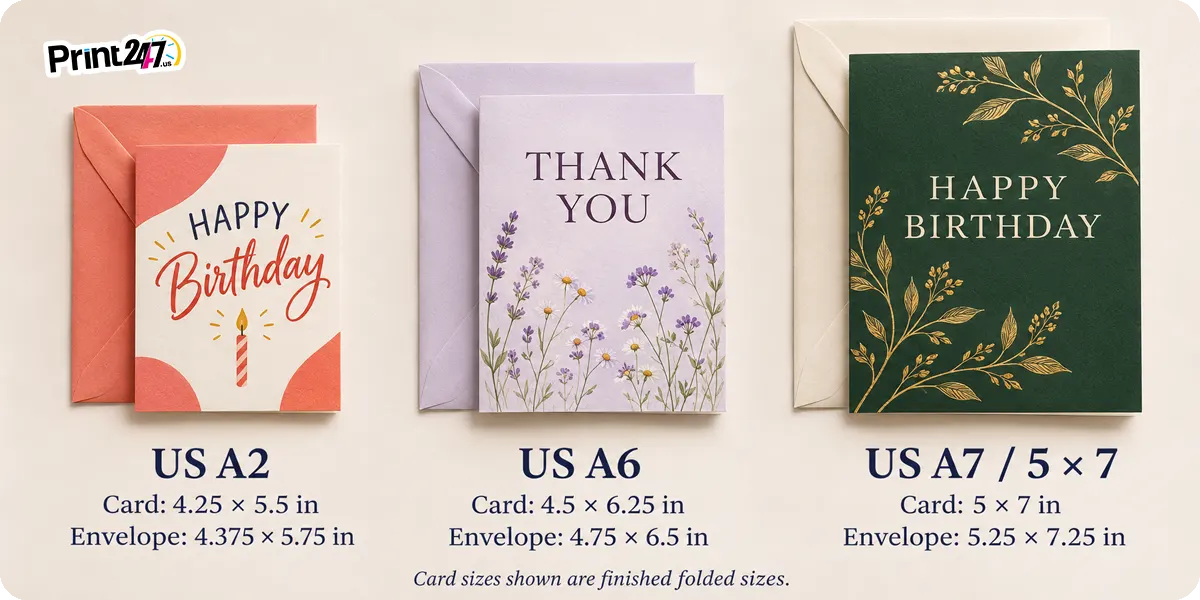
The standard greeting card size in the US is 5 × 7 inches (A7). This size fits perfectly well in a 5.25 × 7.25 inch A7 envelope. 4.25 × 5.5 inches (A2) is another widely used greeting card size. This card size is used for thank-you notes and boxed card sets.
If you are running a stationery brand, sell printable art on Etsy, or run an e-commerce business moving into wholesale, finding the average greeting card sizes is very important. The wrong card size means:
Envelope mismatches
Postage surcharges
Reprints
All of this multiplies cost at wholesale volume. The card size matters more than it seems. This guide covers the standard greeting card dimensions. We will discuss the US A-series and the international ISO sizes. We will also discuss the matching envelope dimensions.
What Is the Standard Greeting Card Size?
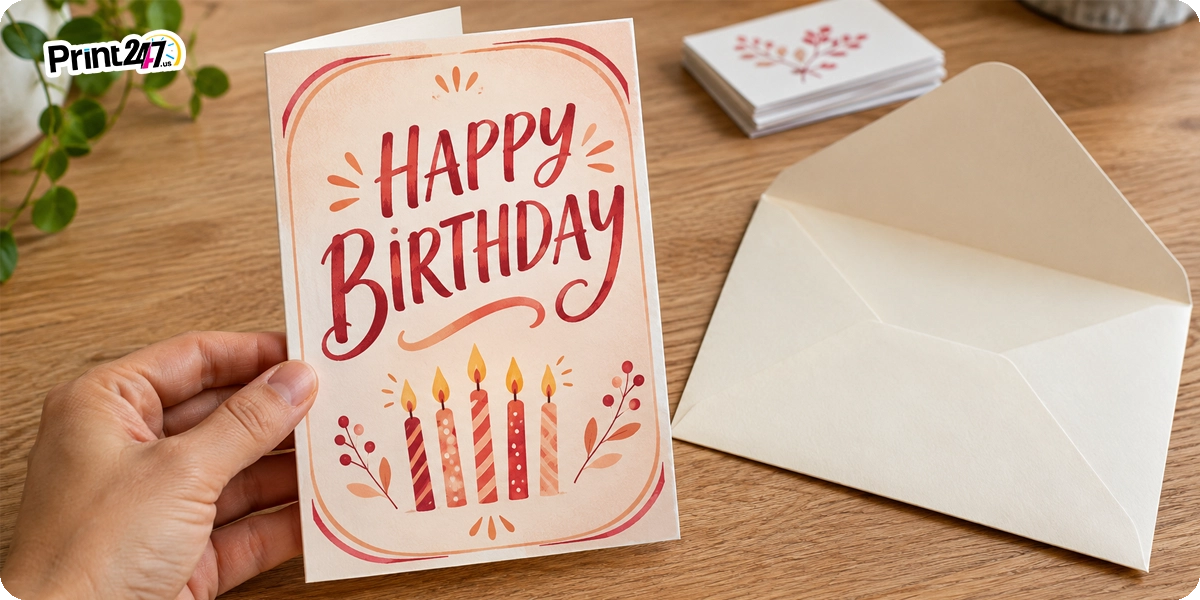
The industry has settled on a few common sizes that count as standard options. That said, there isn’t one official “standard size” for greeting cards. As we discussed before, the standard greeting card size is 5 × 7 inches (12.7 × 17.8 cm) folded. On the other hand, 4.25 × 5.5 inches (10.8 × 14 cm) is a smaller alternative. Many retail brands use the A7 card size for display racks and photo space. Many small batch makers favor the smaller format to manage their paper and printing costs.
US A-Series Standard Greeting Card Size
The table below lists the main US A-series standard greeting card dimensions in inches and cm. We have also added the standard envelope size for each card so it fits easily.
Card size | Folded (in) | Folded (cm) | Flat sheet (in) | Envelope (in) | Best for |
A1 | 3.5 × 4.875 | 8.9 × 12.4 | 7 × 4.875 | 3.625 × 5.125 | RSVPs |
A2 | 4.25 × 5.5 | 10.8 × 14.0 | 8.5 × 5.5 | 4.375 × 5.75 | Thank-you notes, boxed sets |
A6 | 4.5 × 6.25 | 11.4 × 15.9 | 9 × 6.25 | 4.75 × 6.5 | Invitation cards, photo cards |
A7 (5x7) | 5 × 7 | 12.7 × 17.8 | 10 × 7 | 5.25 × 7.25 | Birthday, holiday, wedding; most common |
A9 | 5.5 × 8.5 | 14.0 × 21.6 | 11 × 8.5 | 5.75 × 8.75 | Corporate holiday, milestone, formal |
Flat postcard | 4 × 6 | 10.2 × 15.2 | Single panel | 4.75 × 6.5 | Flat notes, postcard-style cards |
Square 5 × 5 | 5 × 5 | 12.7 × 12.7 | 10 × 5 | 5.5 × 5.5 | Design led cards; extra postage |
Important note: Typical greeting card size is mostly quoted as the folded size. This is the front cover customers mostly see on the shelf. Printing companies in the USA print a 5 × 7 card on a 10 × 7 inch flat sheet. Once the printing is completed, the sheet is scored and folded in half.
International (ISO) Greeting Card Sizes
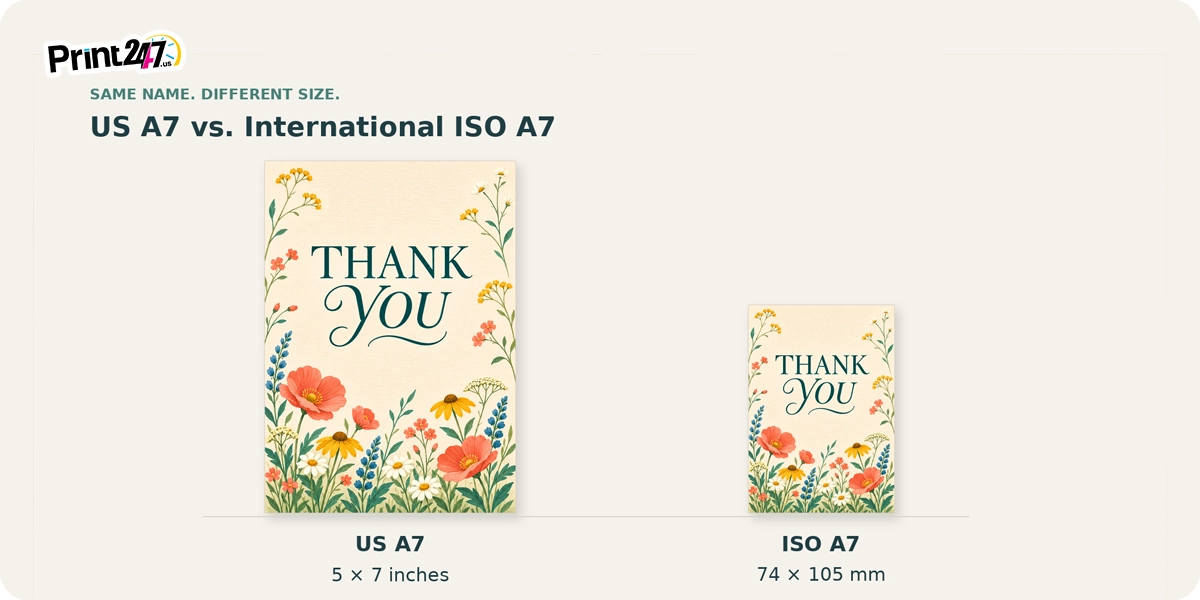
Careful: ISO A7 and US A7 are not the same card. ISO A7 is a 74 × 105 mm mini card. US A7 is the 5 × 7 inch standard above.
We have added another table that lists International ISO greeting card sizes.
Card Size | Folded (mm) | Folded (cm) | Folded (in) | Flat Sheet | Envelope | Best For |
|---|---|---|---|---|---|---|
A7 (ISO) | 74 × 105 | 7.4 × 10.5 | 2.9 × 4.1 | A6 | C7 (81 × 114 mm) | Mini gift cards |
A6 | 105 × 148 | 10.5 × 14.8 | 4.1 × 5.8 | A5 | C6 (114 × 162 mm) | Everyday greeting card |
A5 | 148 × 210 | 14.8 × 21.0 | 5.8 × 8.3 | A4 | C5 (162 × 229 mm) | Premium greeting cards |
DL | 99 × 210 | 9.9 × 21.0 | 3.9 × 8.3 | 198 × 210 mm | DL (110 × 220 mm) | Slim cards |
Small Square | 100 to 145 mm square | 10 to 14.5 cm square | 3.9 to 5.7 in square | 200 to 290 × 100 to 145 mm | 155 × 155 mm | Mini cards |
Large square cards | 150 × 150 | 15 × 15 | 5.9 × 5.9 | 300 × 150 mm | 160 × 160 mm | Christmas and art cards |
What Are Standard Envelope Sizes
The right envelope size selection comes down to one simple rule of thumb that businesses must follow. This rule states:
“The envelope should be about 0.25 inch (6 mm) larger than the card in both width and height. That’s enough clearance to slide the card in without crushing the corners."
This leaves enough room for the card to slide in without bending the corners.
A2 is a slight exception, featuring a narrower 0.125-inch width clearance (4.25-inch card in a 4.375-inch envelope) to ensure a snug fit.
A1 (4-Bar): 3.625 × 5.125 inches
A2: 4.375 × 5.75 inches
A6: 4.75 × 6.5 inches
A7: 5.25 × 7.25 inches
A8: 5.5 × 8.125 inches
A9: 5.75 × 8.75 inches
A10: 6 × 9.5 inches
Square 5.5 or 6.5: 5.5 × 5.5 or 6.5 × 6.5 inches
C6 (ISO) and C5: 4.5 × 6.4 and 6.4 × 9 inches
DL (ISO): 4.3 × 8.7 inches
Folded Card Size vs. Flat Card Size
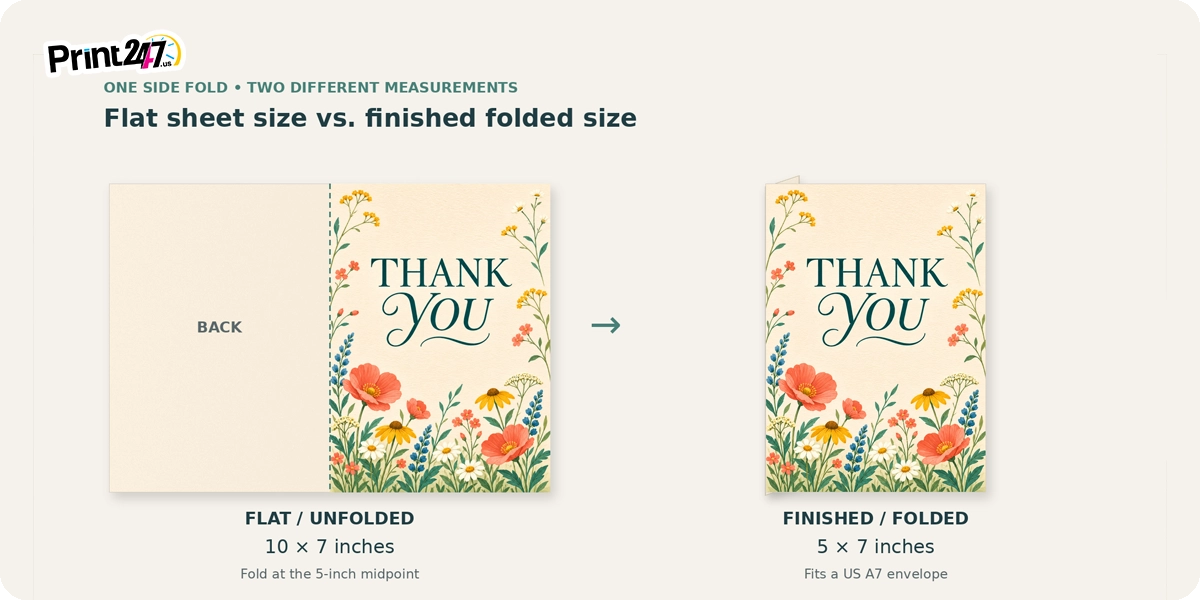
There is a clear difference between folded card size and flat card size.
Folded card size: This is the dimension of the card when it is folded. Stationery shops and envelope charts quote this size. A center fold gives you four panels, so there’s room for a longer message. It also stands on a shelf or desk.
Flat card size: It’s the full, open sheet of cardstock before it’s scored and folded. This is the size you build your file at in software. A card with no fold at all is a different format: a single panel, often used for quick announcements.
Birthday Card Size and Christmas Card Size
B2B buyers often ask, “What size is a birthday card?” or “What is a standard Christmas card size?” The standard size for both birthday cards and Christmas cards is usually 5 × 7 inches (A7). That’s 12.7 × 17.8 cm, mailed in a 5.25 × 7.25 inch envelope.
Most retail brands choose cards in the A2 and A7 sizes. Brands should order both cards and envelopes together. With the holiday season close, place your order early so you don’t run out of stock, as print and shipping times can run long.
How to Set Up a Greeting Card Print File
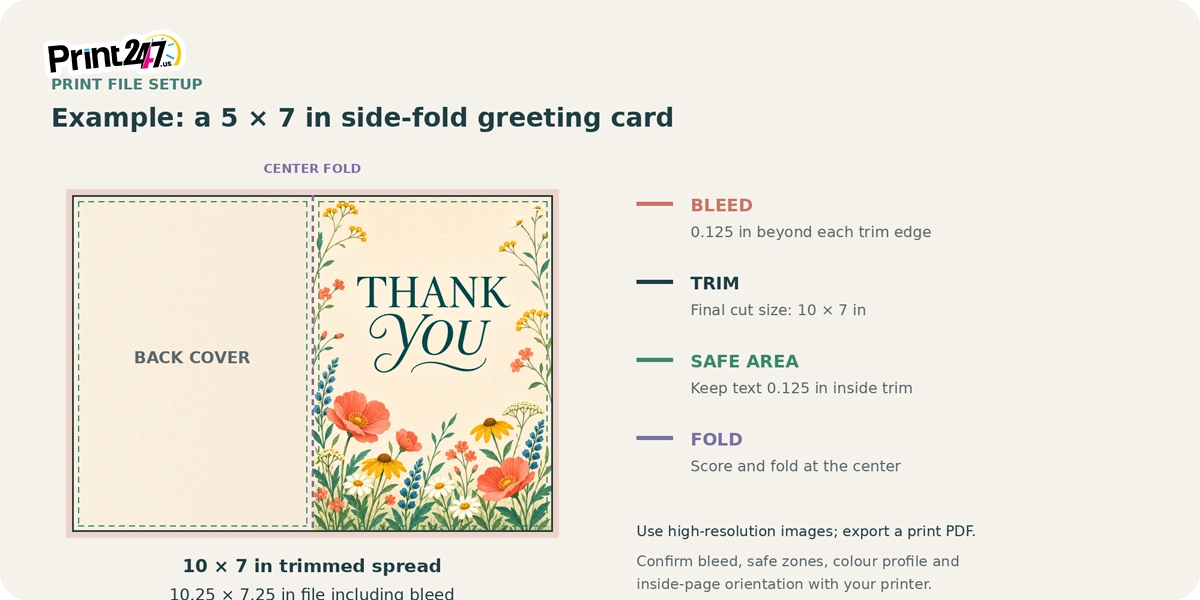
This is one of the most critical parts of the entire printing process. Sellers need to pay close attention to it, as failing at this might cost them money. Don’t send a great design in the wrong file setup that leaves white slivers or cropped text.
Follow these simple steps to set up your design in the right print file:
Build at the flat size
Set up a print file for a standard card size. For example, take a 5 × 7 folded card and make sure the artboard is set to 10 × 7 inches.
Add bleed
Extend background colors and images 0.125 inch (3 mm) past the trim on all four edges. This is done so no white sliver shows after trimming.
Add safe margins
Keep text and logos 0.25 inches away from the trim line and the fold. Adding safe margins means no text gets caught in the crease when the card is folded.
Mark the score line
Place a non-printing guide where the fold falls. Keep the fine lines and small text away from the score lines.
Design resolution
Set your file to 300 DPI.
Color Settings
Use the CMYK color model for professional printing results. This is the standard choice for offset and most digital printers.
Export the file
Convert and export the final design as a print ready PDF with bleed included, and crop marks if your printer asks for them.
What Are the Ideal Greeting Card Paper Weights and Fold Types
Card size and paper weight go hand in hand. Brands need to pick them together. Paper that is too thin for an A7 card will feel cheap and hurt the customer experience. You need to choose the ideal paper weight depending on the standard greeting card size so it offers a premium feel.
Here are some of our recommendations on choosing the cardstock weight for greeting cards:
Weight | GSM | Feel | Ideal for |
80 lb cover | Approx. 216 GSM | Lightweight | Home printing, custom inserts |
100 lb cover | Approx. 270 GSM | Durable | Standard retail cards |
110 lb cover | Approx. 300 GSM | Thick | Birthday and Christmas cards |
130 lb cover | Approx. 350 GSM | Luxurious | Wedding cards |
Fold Types
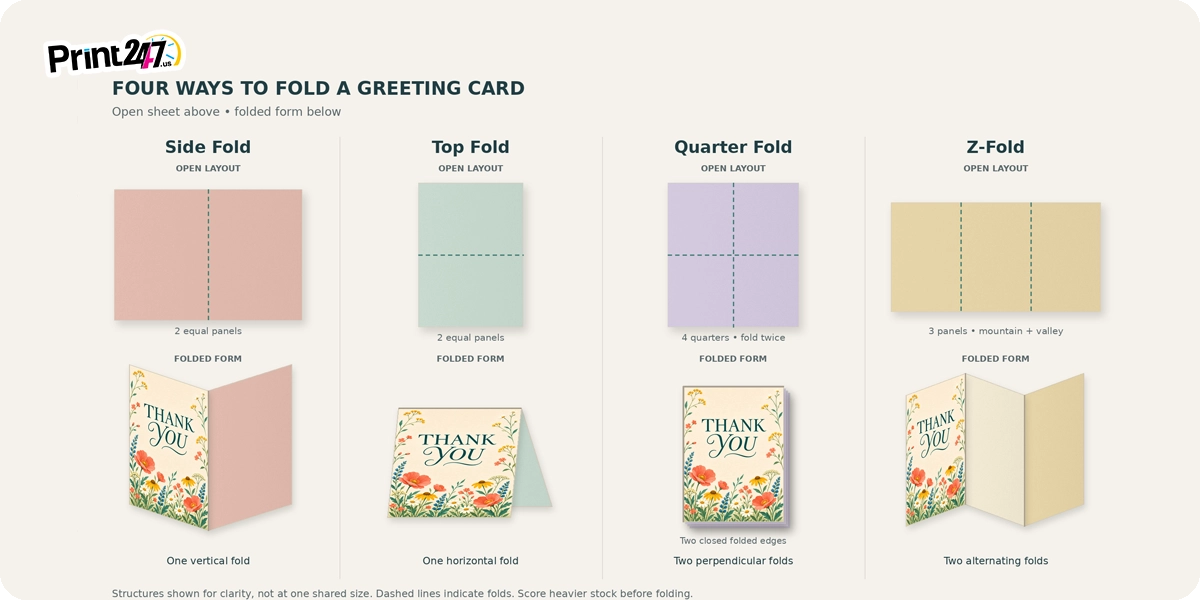
The following are the common fold types for greeting cards (flat sizes shown for a 5 × 7 card):
Side fold: 10 × 7 inches flat
Top fold: 5 × 14 inches flat (It is scored horizontally across the 14-inch length)
Quarter fold: 10 × 14 inches flat
Z-fold: 15 × 7 inches flat
Select the Right Greeting Card Dimensions
Greeting card dimensions depend on:
Where do you plan to sell it?
Who is your target audience?
The design, production, and budget should also be considered. Use the following considerations before picking a standard greeting card size:
Where will it be sold, and what’s the purpose? Define your buyers.
How much needs to be written? Choose a compact card for short messages. Choose larger cards for invitations and detailed artwork.
Check that your card fits in the intended envelope without bending.
Set production cost and decide minimum order quantity. Print247’s greeting card MOQ is 1,000 pieces. The unit price drops as quantity rises.
Finalize your print ready artwork. Make sure it matches your safe area specifications.
Final Thoughts
This guide comes down to one point: pick the greeting card size first, then the rest will follow. The standard greeting card size is 5 × 7 inches (A7). Businesses must match the card with the fitting envelope size so the card doesn’t bend.
Sell your greeting cards at scale using:
100 lb or 110 lb cover
Matte or soft-touch finish
Cello sleeves and boxed sets
This will help your cards look retail-ready. Just pick the right greeting card dimensions. It can help you turn casual buyers into loyal customers. Print247 prints custom greeting cards and matching envelopes in any of these sizes, with free design support.
FAQs
What size envelope do I need for an A2 size card?
An A2 card size easily fits inside a 4.375 × 5.75 inch envelope.
What is the standard gift card size?
The standard gift card size is 3.375 × 2.125 inches (85.6 × 54 mm). The card format for this size is CR80.
What is the ideal size for photo cards?
A7 (5 × 7) is a popular choice for photo cards because it matches the standard 5 × 7 photo print. A6 also works quite well for these cards. Choose the size that meets your specific requirements.
What is the best DPI for A9 greeting card size?
At 300 DPI, the front cover of a folded A9 card measures 1650 × 2550 pixels, while the complete flat spread measures 3300 × 2550 pixels (before bleed).
Get a Quick Quote

More Articles
 Bill ‘Hogg’ Ryan
Understanding the Purpose of Colored Dots on Packaging
 Bill ‘Hogg’ Ryan
Mylar Bags vs Mason Jars: Which Is Better for Long-Term Food Storage?
 Bill ‘Hogg’ Ryan