

Carefully selected materials that deliver exceptional print quality, durability, and shelf presence.


 New
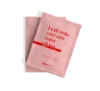
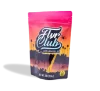



How Minimum Order Quantity Packaging Works for Small and Growing Brands
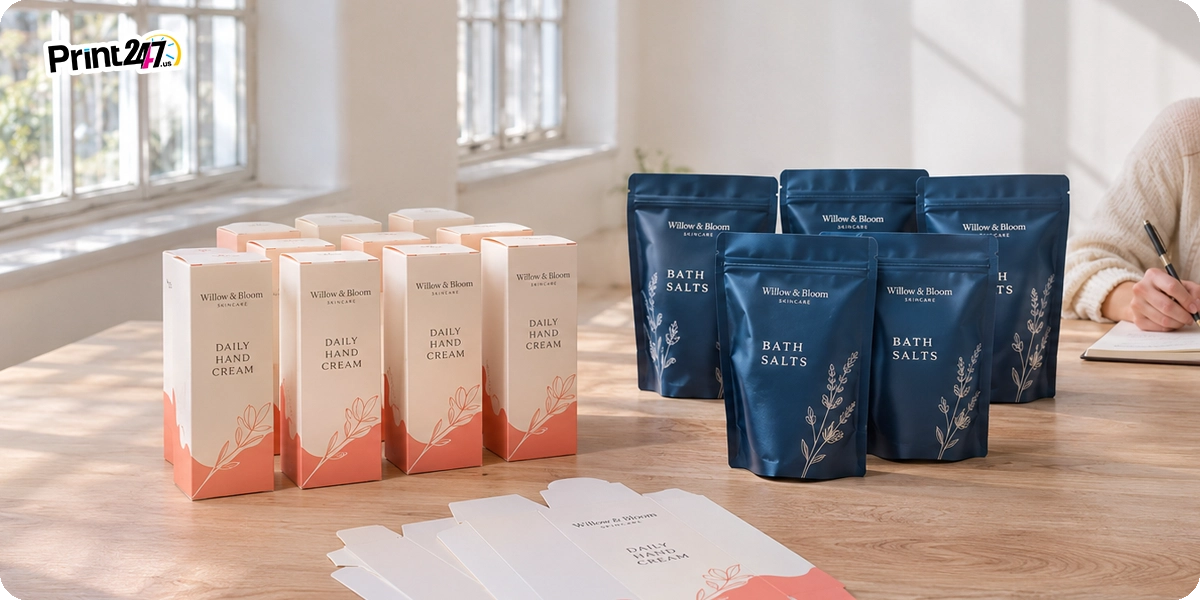
Minimum order quantity packaging is the smallest quantity of boxes, bags, or labels a supplier will print in one order. MOQs exist because every order has fixed setup costs. A small run costs more per unit and a larger run lowers the unit price but ties up more cash.
So you have finalized the packaging design for your product and now the time is order that. You approach a reputable packaging manufacturer for a quote and the reply comes back fast. The price looks fine but the minimum order is 5000 boxes. That can be a point of concern when you ship only 300 orders a month.
That’s where most new brands run into trouble. Minimum order quantity packaging tells you how many units you need to order before a supplier will do your project. Get it wrong and you’ll either be overpaying for every box, or have a year’s worth of packaging in your garage.
To educate brands why suppliers set minimums, what typical MOQs look like for different packaging, and how small orders compare to big ones, we have written this blog. You'll also get a simple way to pick your first order size. It's the math behind smart custom packaging for small businesses seeking to protect cash.
What Is Minimum Order Quantity Packaging and Why Does It Matter?
Minimum order quantity packaging is the smallest number of units a manufacturer will create in one run for your brand. If a supplier has a MOQ of 500 you cannot order 200 of that package. Some suppliers run low MOQs but charge a lot more per unit.
MOQs are not the same everywhere. There are multiple factors affecting this including the packaging type, the printing method, and the supplier's equipment. A digital print shop can take a small batch of mailer boxes. A factory that runs offset presses needs a much larger run in order to justify the setup.
MOQ, Minimum Order Value, and Per-SKU Minimums Are Not the Same Thing
There are a few terms suppliers use that sound alike but work very differently. They include MOQ, minimum order value and per-SKU minimums. In order to find the right packaging for your company, knowing these terms is essential. Confusing these three is how a small-looking quote turns into a big invoice.
The following table shows how each packaging MOQ term affects your order.
Term | What It Means | What It Means for Your Order |
MOQ | The minimum units a supplier will make in one order | You must buy at least this many |
Minimum order value | The lowest dollar total a supplier accepts | Small, low-cost items may need a bigger order to qualify |
Per-SKU minimum | The fewest units needed for each design or size | Three flavors with separate artwork can triple your minimum |
Price break | A quantity where the unit price drops | Ordering a bit more can lower your cost per box |
Brands are surprised by the per-SKU rule most of the time. Always check whether the minimum applies to your entire order or to each design.
Why Every Packaging Supplier Sets a Packaging MOQ
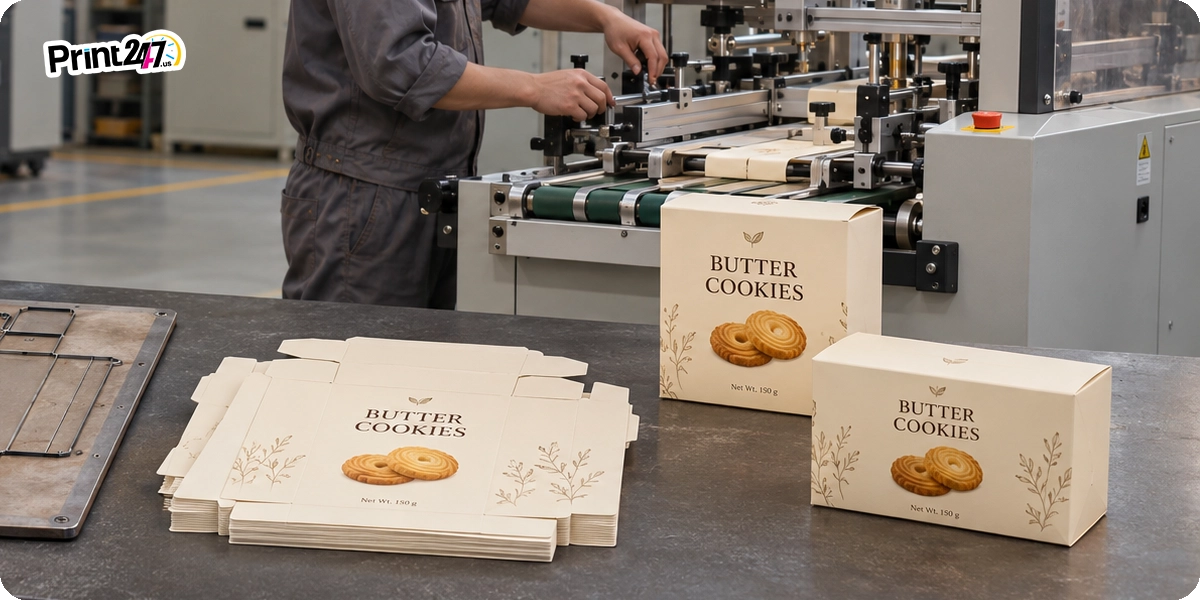
A packaging MOQ is not a way to turn small brands away. It's all about economics. There are always some fixed costs associated with every print job, regardless of the number of boxes printed. Examples include printing plates and die charges. It becomes necessary for the supplier to distribute these costs over the units it produces. Each unit's share increases as the number of units in the run decreases. It is for this reason that economies of scale reward larger orders.
The Setup Costs Hiding Behind Every Production Run
Before a single box comes off the line, the manufacturer has already spent money getting ready. Costs like these appear on almost every job:
Printing plates. Each color of ink requires a separate plate on offset and flexo presses. When there are four colors in a design, there are four plates.
Cutting dies. A die is the custom steel blade that cuts and creases your box shape. A new size or style requires a new die.
Makeready waste. The first sheets through the press are used to line up colors and test cuts. They end up in the recycling bin and not included in your order.
Press setup time. Operators can spend hours loading plates and dialing in the machine.
Material minimums. Paperboard comes in full sheets and film comes on large rolls. A mill sells them in predetermined amounts.
These costs do not change when your order changes. It takes the same die and setup work for a 500 units order and for a 50000 units order.
Typical Minimum Order Quantity for Custom Boxes, Bags, and Labels
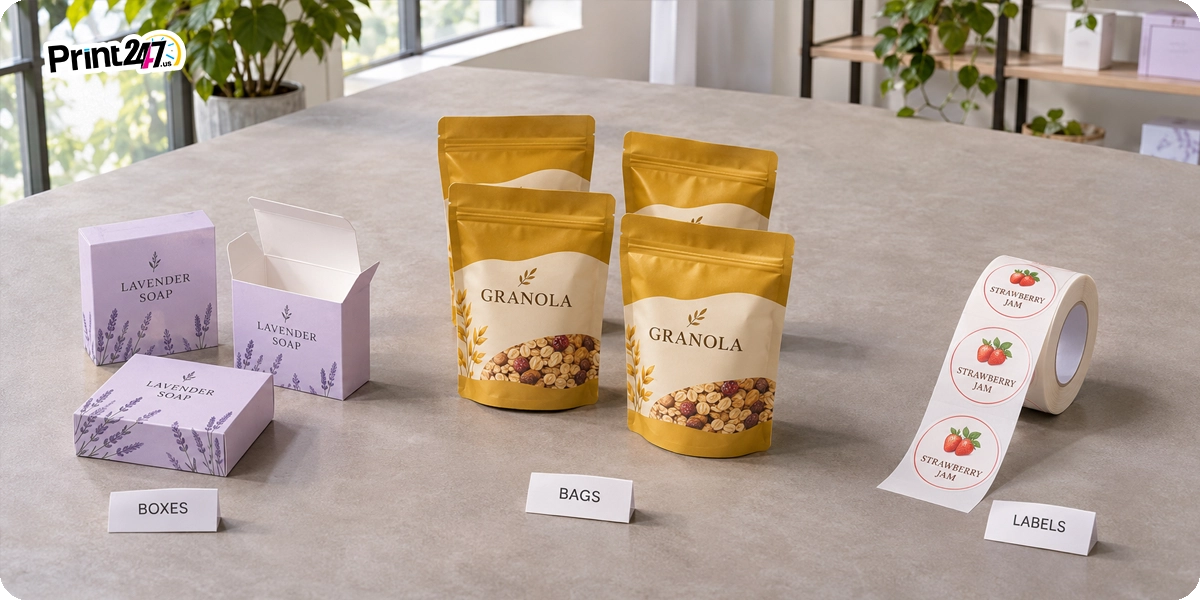
The minimum order quantity for custom boxes depends on the structure, the material, and how it's printed. Here are the typical ranges you'll see from US and overseas suppliers.
Packaging Type | Typical MOQ Range (digital / short-run) | Typical MOQ (offset / standard production) | What Pushes the Minimum Up |
Mailer boxes | 1 – 100 units | 500 – 2,000 units | Offset printing, inside printing, custom inserts |
Folding cartons | 100 – 300 units | 500 – 1,000 units | Foil, special coatings, window patches |
Rigid boxes | 100 – 300 units | 500 units | Hand assembly, wrapped board, magnetic closures |
Corrugated shipping boxes | 1 – 300 units | 500+ units | Custom sizes, flexo printing, double wall board |
Mylar bags | 100 – 1,000 per design | 5,000+ units | Laminated film, zippers, custom sizes |
Stand-up pouches | 100 – 3,000 units | 5,000+ units | Spouts, valves, matte or holographic film |
Custom labels and stickers | 10 – 250 units | 500+ units | Die-cut shapes, specialty stock, foil |
Notice the pattern. If you want custom boxes with a low minimum, look for digital printing and standard sizes. The minimum increases quickly when you add custom sizes, special finishes, or offset printing. The rigid box stays higher because most of the process is done by hand.
Treat these numbers as ranges, not rules. Every supplier sets its own MOQ based on its machines and materials. The typical custom packaging order at Print247 starts at 500 units and it depends on the product and specifications.
How the Printing Method Shapes Your Minimum Order Quantity Packaging Options
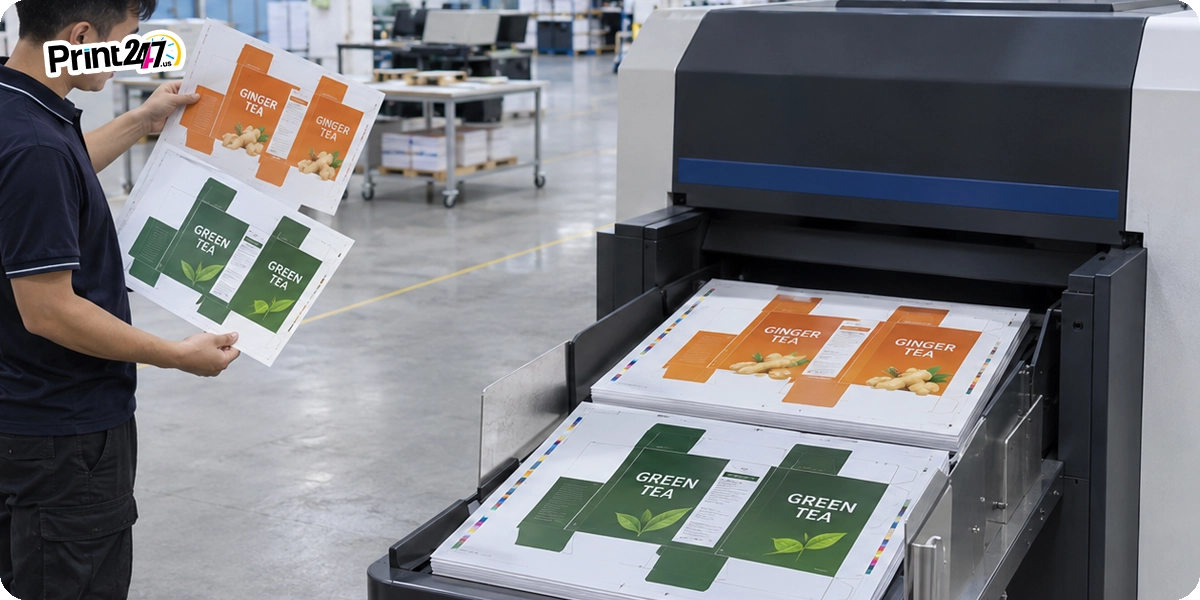
If one thing decides how low your minimum can go, it's the printing method. The setup for digital printing is almost nonexistent, so short runs make sense. Offset and flexo carry real setup cost up front, which only pays off across a big run. A supplier's MOQ can be predicted before you even see the quote if you know which method the supplier uses.
Digital Printing Makes Short Run Packaging Possible
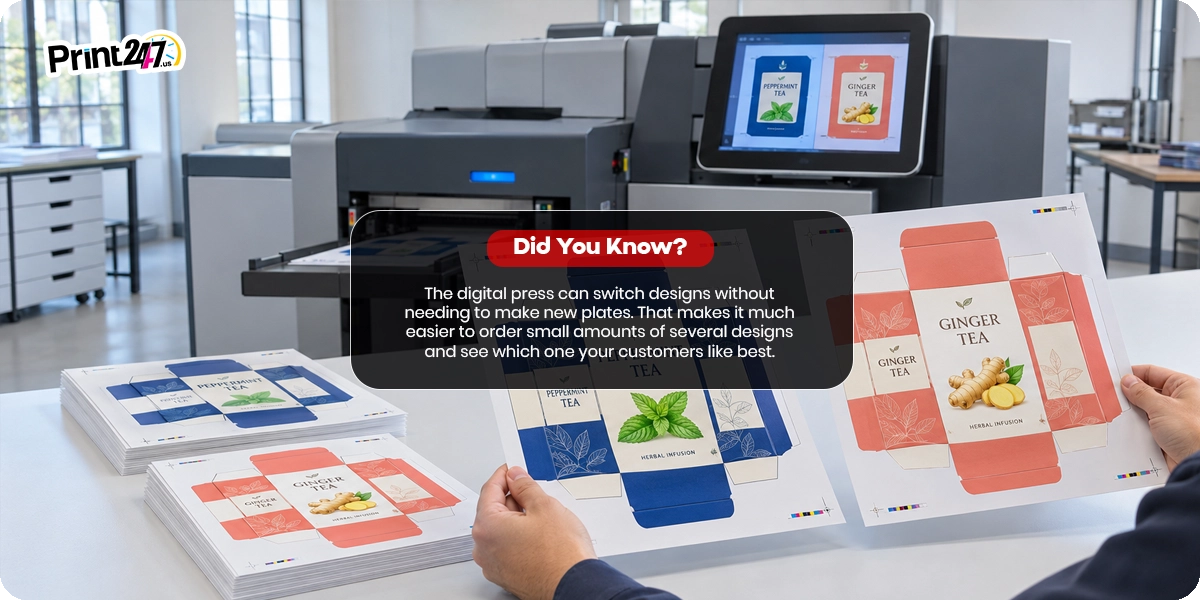
Digital presses print straight from your artwork file. There are no plates to make, so the biggest setup cost disappears. That's why short run packaging and small batch custom packaging have grown so fast in recent years.
Digital printing is a strong fit when you need:
A test batch before a product launch
Several designs or flavors in small amounts
Seasonal or limited edition packaging
Quick reprints with small artwork changes
There is a cost to consider. Unit price stays fairly flat, so it won’t drop at 10,000 units the way offset does.
Offset and Flexo Printing Win on Price for Bigger Runs
Offset lithography and flexographic printing are the workhorses of big packaging runs. There is a real setup time involved in both. Both use plates. Once the press is running, however, they move quickly and use ink efficiently. So your unit price will decrease as your order grows.
Offset printing is common for folding cartons and rigid box wraps that need fine detail. Flexographic printing is suitable for labels and film rolls.
Here's how the three methods compare:
Method | Typical Run Size | Setup Cost | Unit Cost as Volume Grows | Best For |
Digital | 25 to 5,000 | Low | Stays fairly flat | Tests, launches, many SKUs |
Offset (litho) | 1,000 and up | High | Drops a lot | Cartons, rigid box wraps |
Flexographic | 500 and up | High | Drops the most at high volume | Corrugated, labels, film rolls |
Once your volume is steady, move to offset or flexo if you'll be ordering the same box for years. That's where the long-term savings live.
How to Choose the Right Quantity for Your First Packaging Order
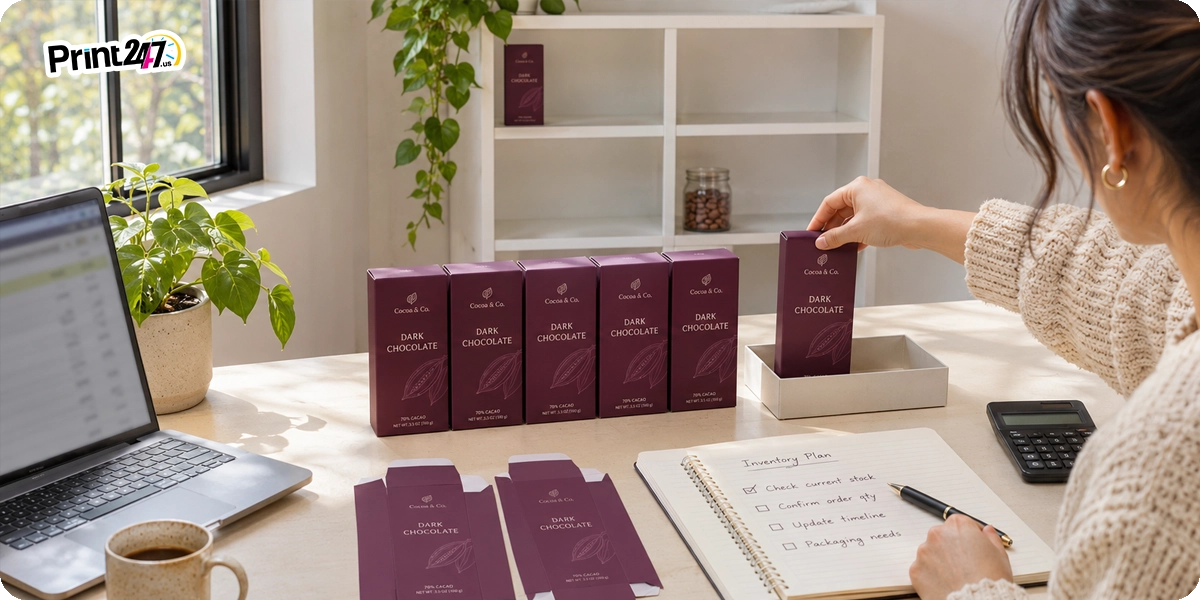
The majority of brands either take the supplier's minimum price or try to find the cheapest unit price. They both have the potential to backfire. It takes about five minutes and three steps to create custom packaging for small business orders. If you use your real numbers, you'll find an order size that suits your cash flow and your sales.
Step 1 - Figure Out How Much Packaging You Use Each Month
It's an important step and counts only real numbers. Don't start with what you hope to ship next year, but with what you are shipping today.
Review your last three months' average monthly orders.
Leave ten percent as a buffer for damaged boxes and sales spikes.
Calculate how many months of supply you need. Most growing brands need three to six months to get off the ground.
Here's a quick example.
A candle brand ships about 400 orders a month. With a 10% buffer, that's 440 boxes. Four months of supply comes to 1,760 boxes. Round it up to 1,800, and that's a smart starting point. This number also sets your reorder point. When your stock drops to about one month's supply, place the next order.
Step 2 - Adjust for Design Changes and Storage Space
Next, take a look ahead. Will anything on your packaging change in the next few months? New packaging can become outdated when a new logo appears, a new ingredient appears, or a new claim such as "now vegan" appears. You should cut your quantity if a change is likely, so it only covers the time before the change.
Then check your space. Even flat-packed, 1,800 mailer boxes take up real room. If you pay for storage, you should also account for the cost of carrying inventory. Unused stock is the most expensive packaging there is: you paid for it and it never shipped.
Step 3 - Compare Your Number to the Next Price Break
Last, ask your supplier for pricing at your number and at the next tier up. Then compare the total cost, not just the unit price.
Say 1,800 boxes cost $1.40 each and 2,500 cost $1.15 each. That's $2,520 versus $2,875. For $355 more, you get 700 extra boxes, which covers about seven more weeks of orders. If your design is stable, that's a good deal. If a rebrand is coming, it's wasted money.
Large companies call this finding the Economic Order Quantity, or EOQ. You're doing the same thing with minimum order quantity packaging, just without the formulas.
How to Order Small Batch Custom Packaging Without Overbuying?
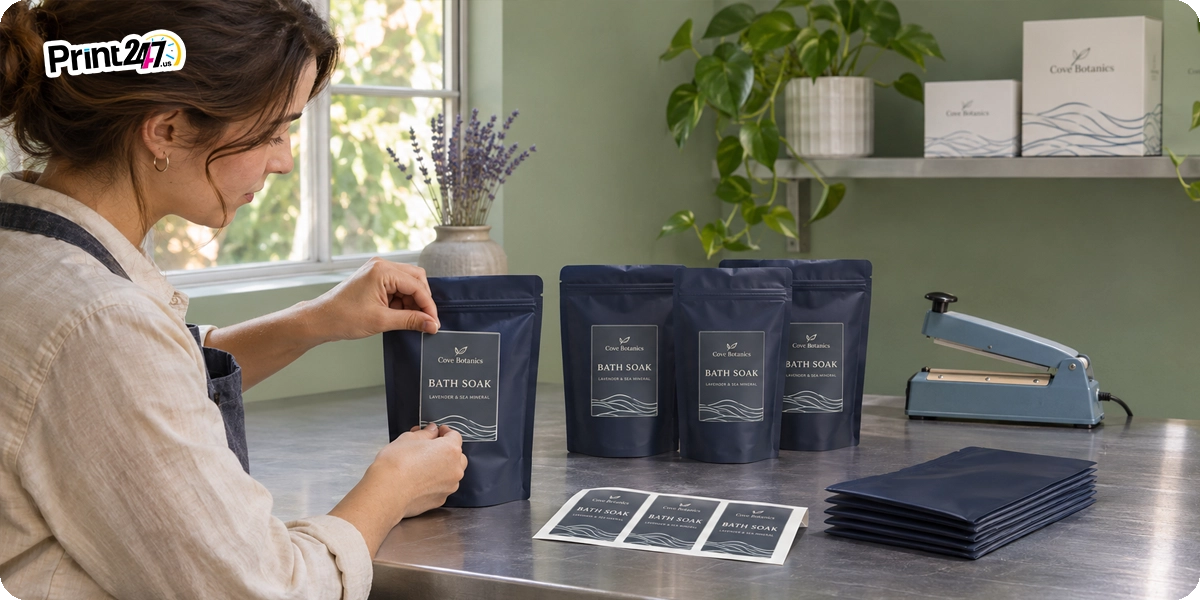
You don't have to choose between a huge minimum and plain brown boxes. These measures help small batch custom packaging go further:
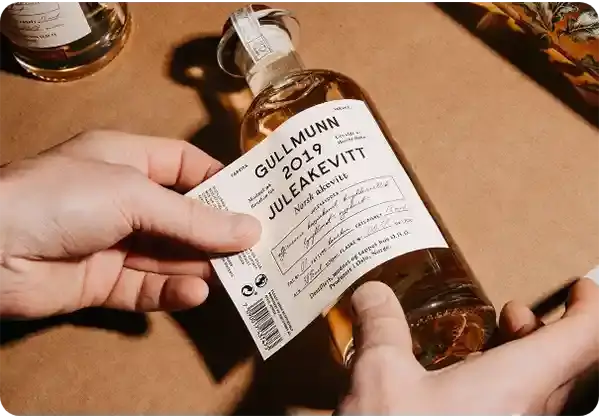
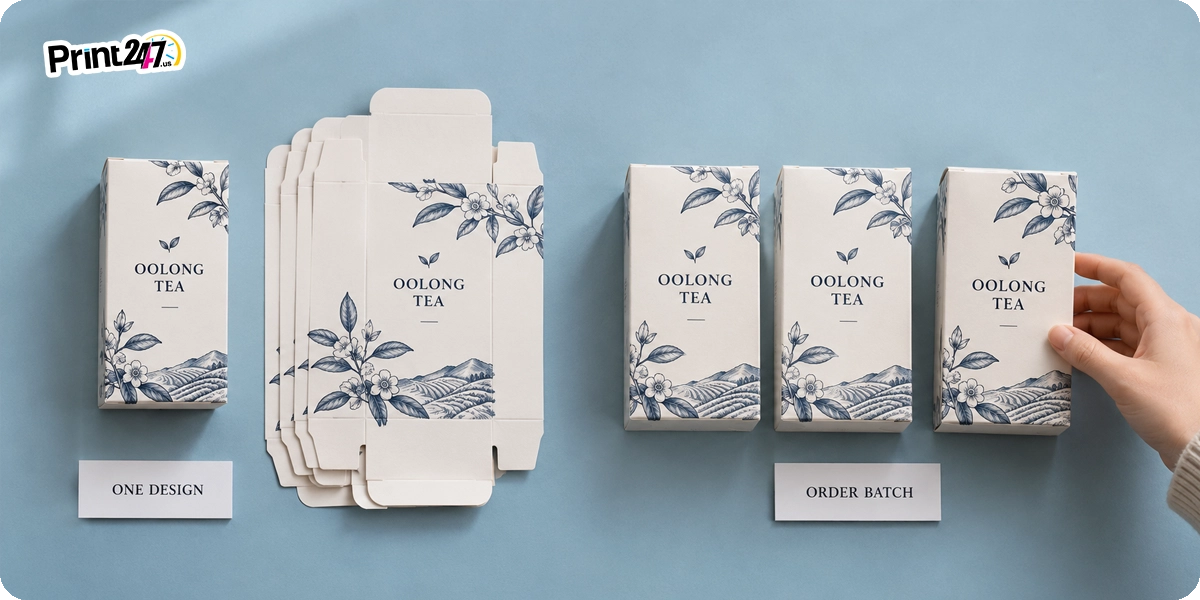
Use one box with different labels. Print one mailer or carton for your whole line. Then add custom labels and stickers for each product. One box MOQ covers every SKU.
Standardize your sizes. Fit your products into one or two box sizes. Fewer sizes means fewer dies, fewer minimums, and custom boxes with a low minimum per size.
Combine designs when your supplier allows it. Some suppliers let you split one run across several designs of the same size. Ask first and you may meet the minimum faster.
Release in stages. Order enough for your launch, then reorder as sales come in. You pay a little more per unit but take on far less risk.
Dress up a standard box for the seasons. Your regular box can be dressed up with a holiday sticker or printed sleeve for a fraction of the cost of a complete seasonal run.
Order samples first. You should feel the board, see the print, and compare finishes before proceeding. Print247 offers sample kits and standard samples for exactly this step.
Next Actions for Choosing the Right Packaging MOQ for Your Brand
Lowest MOQ is not necessarily the best value. The ideal package MOQ is a compromise between 4 things: unit price, cash, storage space, and how soon your design might change.
If you wish to place an order before the end of the year, take these three steps:
Multiply your monthly usage by three to six months.
Reduce that number if a design or label change is in the works.
Calculate the total cost at your number and at the next price break.
Once you do that, you won't have to guess anymore. Your small business will benefit from custom packaging products that fit today's sales and scale with the needs of tomorrow. Get Print247 to quote two or three quantities side by side and then let the numbers make the call.
FAQs
What is a good minimum order quantity for a small business?
A good MOQ matches three to six months of your real sales. The average small brand sells between 500 and 2000 units per design.
Can I order custom packaging with no minimum order?
Yes. Some digital print shops sell custom boxes in very small amounts. It can sometimes be as few as one to 25 units. Expect a much higher price per box from them. Plain stock boxes with custom stickers are usually the cheapest choice.
Why does low MOQ custom packaging cost more per unit?
Every print task has fixed setup costs. This includes plates & die charges and press time. Each box carries a bigger share of the costs with a small order, since those costs are spread over fewer units. A larger run spreads the costs thinly.
Is the packaging MOQ per design or per order?
It all depends on the packaging supplier. There are many companies that set the minimum for each design or size. So three designs may mean three separate minimums. Be sure to ask how your quote counts each SKU before you approve it.
How many custom boxes should I order the first time?
Use this quick formula to know exactly the quantity of custom boxes:
Take your average monthly orders.
Add a 10% buffer.
Multiply by three to six months.
Then compare that total with the next price break before you order.
Get a Quick Quote

More Articles
 Bill ‘Hogg’ Ryan
How Packaging Tariffs Change the Real Cost of Imported vs. US-Made Packaging
 Bill ‘Hogg’ Ryan
10 Food Packaging Designs That Sell More in 2026
 Bill ‘Hogg’ Ryan